Irrigation Revives Avocado Farming, Boosts Harvests and Creates Rural Jobs in Nyanza District
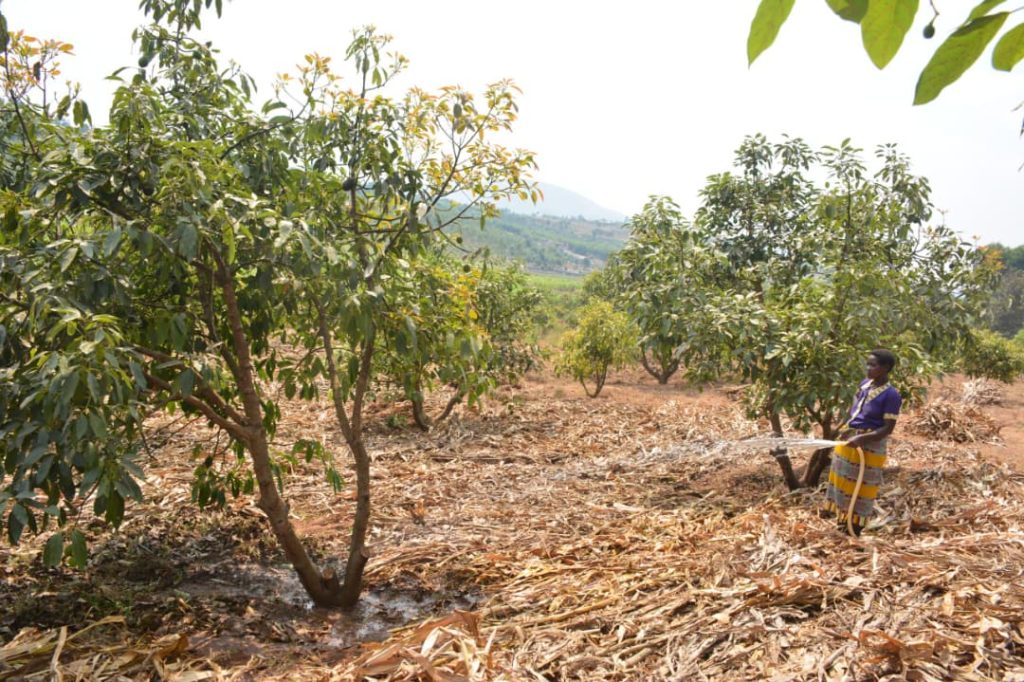
Reliable irrigation is breathing new life into orchards that once struggled to survive, enabling farmers to increase production, expand market opportunities, create employment, and build resilient agricultural businesses. What was once a risky investment has become a promising model of climate-smart agriculture, demonstrating how access to water can unlock the full potential of Rwanda’s farming sector.
The transformation is being driven through the Sustainable Agricultural Intensification and Food Security Project (SAIP), implemented by the Rwanda Agriculture and Animal Resources Development Board (RAB) through the Single Project Implementation Unit (SPIU). By promoting Small-Scale Irrigation Technologies (SSIT), the project is helping farmers cultivate throughout the year, improve productivity, strengthen food security, and withstand the growing effects of climate change.
Among the beneficiaries is Kayihura Claver, an investor who owns a 7.5-hectare avocado plantation in Mwima Village, Rwesero Cell, Busasamana Sector, Nyanza District. The plantation is managed by agronomist Landuald Mugwaneza, who oversees more than 2,006 avocado trees planted in different phases.
According to Mugwaneza, establishing the orchard was extremely challenging before irrigation became available.
“When the avocado trees were still young, many of them dried up because we had no reliable source of water,” he explained. “Everything changed after receiving irrigation support through RAB. Since then, we have had enough water to irrigate the plantation, and no more trees have dried up. Production has increased significantly.”
Today, the orchard is already producing about four tonnes of avocados annually, with expectations of even greater harvests as more trees reach full maturity.
The improved irrigation system has also opened new market opportunities.
“We first sold about 600 kilograms of avocados. As production increased, we were able to supply four tonnes to the market,” Mugwaneza said. “Water is the most important nutrient for any crop. Proper irrigation has enabled us to apply fertilizers effectively, resulting in healthier trees and better yields.”
He emphasized that irrigation has not only improved production but has also transformed daily farm operations.
Before the modern irrigation system was installed, workers had to carry water manually using jerrycans a labor-intensive process that consumed time, increased production costs, and limited the growth of the orchard.
“Today, irrigation has made farming much more efficient. We can water the entire plantation consistently, something that was nearly impossible before,” he added.
The project has also become an important source of employment for surrounding communities. Depending on the farming season, the plantation employs between 80 and 100 permanent and casual workers, providing stable incomes for many rural households.
The irrigation infrastructure required an investment valued at RWF 66.4 million, of which the beneficiaries contributed more than RWF 16 million, while SAIP II provided over RWF 49 million in financial support to install the irrigation system across the 7.5-hectare farm.
According to Innocent Nzabamwita, Irrigation Engineer Specialist at RAB-SPIU, the Government of Rwanda has introduced subsidy schemes designed to make modern irrigation technologies more affordable for farmers.
“Farmers cultivating between 0.5 and 10 hectares receive a Government subsidy covering 50 percent of irrigation equipment costs, while they contribute the remaining 50 percent,” he explained.
Nzabamwita added that the Government provides even greater support for farmers investing in environmentally friendly irrigation systems.
“Farmers cultivating between five and ten hectares using solar-powered irrigation pumps contribute only 25 percent of the investment, while the Government finances the remaining 75 percent,” he said.
He noted that these subsidies are removing one of the biggest financial barriers preventing farmers from investing in irrigation technologies, enabling thousands of producers to modernize agriculture, improve productivity, and increase household incomes.
According to Nzabamwita, the initiative also contributes directly to the implementation of Rwanda’s National Strategy for Transformation (NST2) 2024–2029, which seeks to achieve annual agricultural growth of more than six percent while expanding the country’s irrigated agricultural land from 74,375 hectares to 132,171 hectares.
He further explained that SAIP II promotes collective action by prioritizing farmer groups and cooperatives, allowing more farmers to benefit from irrigation technologies while strengthening collaboration in production, value addition, and market access.
Under the Small-Scale Irrigation Technologies component, the project’s investment continues to expand nationwide. Phase I has already invested approximately RWF 5.35 billion in irrigation systems, laying the foundation for climate-smart agriculture across Rwanda.
About The Author


SUBSCRIBE TO OUR NEWSLETTER