AfricaRice Strengthens Strategic Partnerships with Leading Chinese Research Institutions to Accelerate Rice Innovation in Africa
In a significant step forward international rice research collaboration, a delegation from Africa Rice Center (AfricaRice) led by its Director General, Dr. Baboucarr Manneh, recently undertook an official mission to China, engaging with five of the country’s foremost agricultural research institutions that saw the signing of cooperation agreements, firming up concrete joint research roadmaps, and a landmark scientific breakthrough.
Signing Ceremony I: AfricaRice and HNAAS Formalize Strategic Partnership
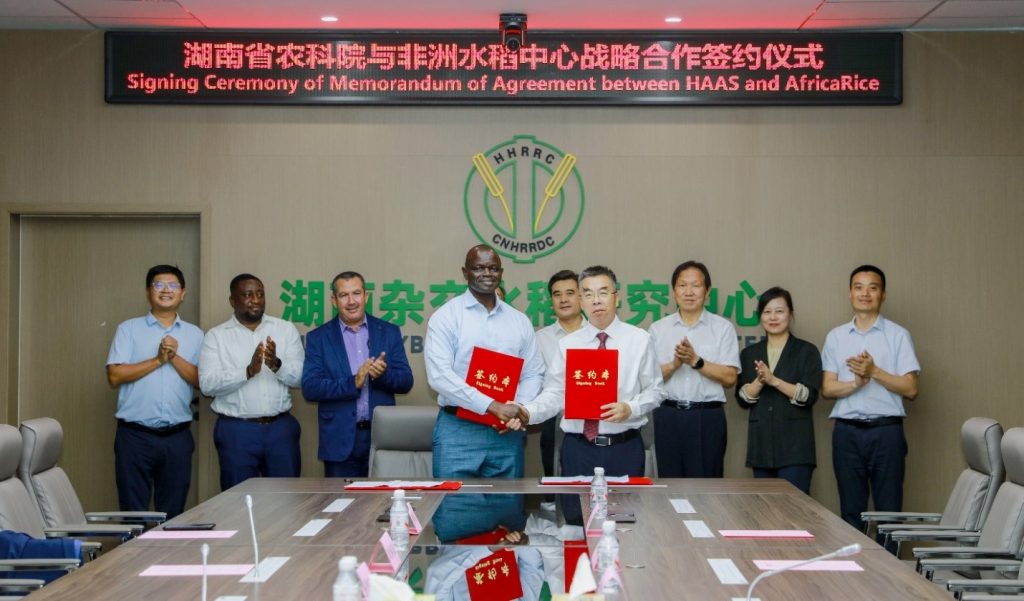
The first major milestone of the mission came on 27 May, when AfricaRice and the Hunan Academy of Agricultural Sciences (HNAAS) signed a Strategic Cooperation Agreement in a formal ceremony attended by senior representatives of both institutions. The agreement was signed by Dr. Baboucarr Manneh on behalf of AfricaRice and Prof. Yu Yinghong, President of HNAAS, on behalf of the Academy. The HNAAS is one of China’s most prestigious agricultural research bodies, with the Hunan Hybrid Rice Research Center (HHRRC) as a key affiliate. The HNAAS brings to this partnership, deep expertise in hybrid rice breeding, molecular genetics, and technology dissemination. The agreement provides a long-term framework for joint research, scientist exchanges, and capacity development, with HHRRC designated as the lead unit for implementation of AfricaRice–HNAAS cooperation activities.
Signing Ceremony II: AfricaRice and CNRRI Establish a Joint Laboratory for Rice Research and Innovation
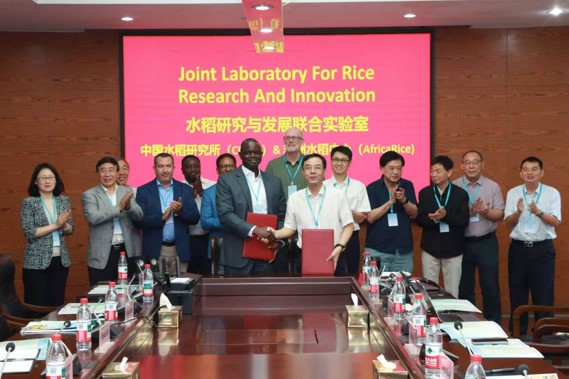
The second major milestone was chalked on 30 May, when AfricaRice and the China National Rice Research Institute (CNRRI) held a signing ceremony to formalize their Cooperation Agreement for a Joint Laboratory for Rice Research and Innovation. The agreement which was signed by Dr. Jiang Renhua, Director General of CNRRI, and Dr. Baboucarr Manneh on behalf of AfricaRice was witnessed by officials from the two institutes and representatives from the Chinese Academy of Agricultural Sciences (CAAS) and Clonal Rice Project leadership. The CNRRI is the main national research program with a rice mandate and operates China’s national rice genebank and a nationwide research network spanning breeding, quality testing, and cropping systems, making it one of the country’s foremost rice research institutions. The joint laboratory framework creates a dedicated platform for collaborative research, technology transfer, and human capacity development, with an early emphasis on accelerating the transition of African rice production systems toward higher-yielding irrigated systems supported by mechanization and modern breeding tools.
Productive discussions were also held with the Shanghai Agrobiological Gene Center (SAGC) and Zhejiang Agriculture and Forestry University (ZAFU), both of which expressed strong interest in formalizing partnerships with AfricaRice. Priority areas identified include germplasm exchange, improved variety evaluation under African conditions, rice processing technologies, mechanization, and renewable energy applications in agriculture.
Science at the Center: The HHRRC Symposium
During a dedicated scientific symposium with the Hunan Hybrid Rice Research Center (HHRRC), a globally recognized hub for hybrid rice innovation, research teams from both institutions explored co-development of technologies tailored to Africa’s unique production challenges. Discussions centered on third-generation hybrid rice breeding systems based on gene-edited male sterility, molecular breeding, and the identification of innovations ready for deployment across the continent. Both sides agreed to align breeding priorities and develop a roadmap for training African scientists at MSc, PhD, and postdoctoral levels.
A Breakthrough for the Future of Rice Seed Systems
The mission culminated in the 2026 Annual Meeting of the Gates Foundation-funded Clonal Rice Project which brought together international partners to review scientific progress toward a transformative goal: rice varieties that retain high hybrid performance across successive generations — eliminating the need for farmers to purchase new seed every season.
The third milestone came as a historic progress from the Clonal Rice project: two hybrids developed by AfricaRice have been successfully gene-edited with no traces of foreign DNA. This breakthrough is a critical proof of concept on the road to commercially deployable clonal rice and has significant implications for seed system sustainability, food security, and farmer autonomy across Africa.
Dr. Manneh commended the research teams for their rapid progress, emphasizing that “stronger international partnerships will play a critical role in delivering innovative technologies that improve productivity, enhance food security, and reduce Africa’s dependence on rice imports.”
About The Author


SUBSCRIBE TO OUR NEWSLETTER