Greenhouse Farming: MUKANDAYISENGA’s Journey to Enhanced Yields and Financial Stability

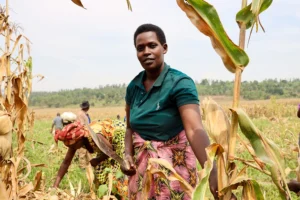
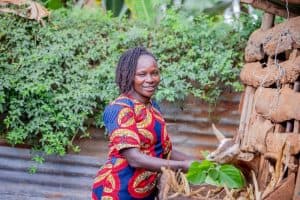
Donathile MUKANDAYISENGA, a committed farmer from Kigarama Cell, Nzige Sector, Rwamagana District, firmly believes that greenhouse farming is far superior to traditional open-field farming. Through her journey, she has demonstrated how modern agricultural technologies can revolutionize farming and improve livelihoods.
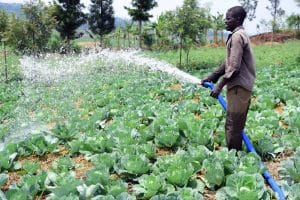
MUKANDAYISENGA began farming in 2020 with open-field cultivation, facing challenges such as unpredictable weather, pest infestations, and limited capital. Determined to enhance her farming efficiency and profitability, she sought innovative solutions. In 2023, she secured an 85% matching grant from the Sustainable Agricultural Intensification and Food Security Project (SAIP)—amounting to 19 million Rwandan Francs—which enabled her to establish a greenhouse equipped with an advanced irrigation system. This investment marked a turning point in her agricultural enterprise.

Now, operating on a 540m² plot, she cultivates high-quality peppers in her greenhouse, achieving an impressive yield of 6 tons per season. Greenhouse farming has provided her with consistent production, better crop quality, and higher profits. Compared to open-field farming, greenhouse yields can be up to six times greater due to improved pest and disease control, efficient water management, and stable climatic conditions.
“The difference is that farming in a greenhouse requires less capital for irrigation and fertilizers because it is done on a small scale but yields high output,” MUKANDAYISENGA explained.
“The way a greenhouse is built protects the plants inside, ensuring better productivity.”
One of the major advantages of greenhouse farming is its independence from seasonal weather changes. Unlike open fields, where crops are vulnerable to droughts and heavy rains, greenhouse farming ensures a stable food supply throughout the year.
SAIP played a crucial role in MUKANDAYISENGA’s transition to modern farming techniques. Beyond helping her establish a greenhouse, SAIP also enabled her to expand into value addition by processing her chilies into chili powder. This diversification has significantly increased her income and market reach.

With SAIP’s support, she has achieved notable milestones: Growing high-quality sweet peppers and cucumbers, generating 11 million RWF in profit from improved yields, and transforming chilies into chili powder to reach wider markets.
“I have achieved many goals because the production from my greenhouse helped me build my own house worth Rwf 12 million. It also enables me to pay my children’s school fees and cover other daily needs,” she said.

Vincent SEZIREGA, a worker in MUKANDAYISENGA’s greenhouse, emphasized the advantages of greenhouse farming, stating, “The difference with greenhouses is that what you plant inside yields far more compared to crops grown in the open field. It’s all because of controlled conditions, unlike outside where crops are affected by rain and sun.”

Radjab MBONYUMUVUNYI, Mayor of Rwamagana District, highlighted SAIP’s broader impact on the district’s agricultural landscape. He noted that SAIP has significantly contributed to the establishment of greenhouses, production of high-quality export crops, and the preparation of the 280-hectare Nyirabidibiri wetland for agricultural use. The project has also empowered farmers through training, matching grants, and small-scale solar-powered irrigation technology (SSIT).
Beyond food security, SAIP has strengthened rural economies in Rwamagana. Many farmers who once relied on subsistence agriculture now produce surplus crops, invest in property, and support their children’s education. Over 1,000 jobs have been created through SAIP’s irrigation and agricultural projects, enhancing household resilience.
SAIP, funded by the Global Agriculture and Food Security Program (GAFSP) through the World Bank and implemented under the Rwanda Agriculture and Animal Resources Development Board (RAB), aims to enhance agricultural productivity, improve market access, and strengthen food security.
Through its matching grants, SAIP has enabled farmers to scale up production, diversify income streams, and add value to their produce. Over 45,000 farmers benefited from the program’s first phase, and the second phase aims to reach 20,000 more by the end of 2024. Currently, 51% of allocated funding has been distributed, with 31% invested in various agricultural initiatives.
MUKANDAYISENGA’s success story reflects how women farmers are driving Rwanda’s agricultural transformation through innovation and strategic investments. By embracing innovation, farmers can achieve higher productivity, financial stability, and long-term sustainability in agribusiness.


About The Author


SUBSCRIBE TO OUR NEWSLETTER