The Role of Masaka Incubation Centre in Promoting Entrepreneurship and Job Creation

For over a decade, the Masaka Business Incubation Centre has been a hub for young and small-scale entrepreneurs, helping them turn their business ideas into profitable ventures.
Located in Masaka Sector, Kicukiro District, City of Kigali, the center was established in 2011 by the Rwanda Development Board (RDB) to provide business advisory services (BDA). Over time, it expanded its services to include agro-processing, leather production, and arts and crafts.
A collective assessment revealed that between 2021 and 2024, the center hosts approximately 215 young entrepreneurs annually, offering training in vocational and technical skills, internships, and support for individuals from the informal sector or seeking to scale up their businesses in the acceleration phase.
Entrepreneurs Benefiting from the Centre
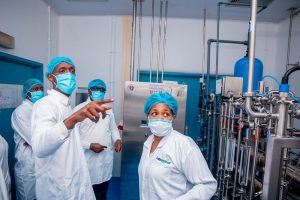
Samuel Kayitera, an entrepreneur, has been developing a grape wine production business.
“I registered my company in 2018 but struggled to obtain the necessary permits. However, after securing space at Masaka Incubation Centre, the process became easier. I gained access to a proper working environment and essential equipment, including machines that would have been expensive to purchase or rent. I have now obtained all the required quality certifications and am ready to launch my product on the market,” he said.
His current production capacity allows him to process 1,000 kg of grapes daily, which he imports from neighboring countries at Rwf 4,000 per kilogram. Producing one liter of wine requires 1.5 kg of grapes, and a single bottle sells for Rwf20,000. The wine takes four months to be fermented, and during a visit by Topafricanews last month, he had 3,000 liters ready for the market.
One of his major challenges is the high cost of packaging materials, as Rwanda lacks a local glass bottle manufacturing plant. Importing bottles requires bulk orders, which poses financial constraints.

Clementine Mukantezimana, the head of Noza Bamboo Ltd, received training at Masaka Incubation Centre in 2022 and was provided workspace for her bamboo weaving business. Working alongside her team, she produces various bamboo-based products.
She expressed her satisfaction, stating, “I am earning money and no longer count myself among the unemployed. I also provide jobs for others. I save a portion of my income to ensure that when my incubation period ends, I will have the means to establish my own workspace.”
However, she highlighted challenges, including limited innovation due to the absence of a computer lab for research, scarcity of bamboo supplies, and a lack of advanced machinery for processing bamboo.

Usanase Aimée Sandrine, an artist, who also benefits from the incubation center. After graduating from Ecole d’Arts de Nyundo (2016-2018), she specialized in sculpture and ceramics. She creates decorative pieces for hotels and residential homes, as well as stage designs for musicians using old materials.
Currently, she employs four permanent staff at her company, Ikirezi, and aspires to expand her business while raising awareness of the value of art as a profession.

Ngirabacu Anastase, the founder of Sakaza Fruit Processing, trained at the center in 2021 and later developed a business producing fruit-based wine. His initiative aims to provide a reliable market for local farmers and contribute to job creation.
His wine products, made from a blend of pineapples and ginger, as well as mixed fruits, have been on the market since 2022. The production cycle takes 14 days, and he currently supplies 200 crates per batch. His business has created 12 job opportunities.
Challenges Hindering the Centre’s Effectiveness
Safari Gilbert, Director of Masaka Business Incubation Centre, acknowledged that the facility is struggling to meet demand due to inadequate infrastructure and limited staff capacity.
“The center needs a technician who can also provide entrepreneurship training to our incubatees. Our staff lack advanced entrepreneurial skills because they do not receive regular training to enhance their expertise,” he explained.
He also pointed out financial constraints, stating, “Entrepreneurs need both technical and financial support. We should be able to reward innovation, facilitate participation in networking events, and assist with certification processes. Unfortunately, we lack the budget to support these crucial aspects, which slows down the progress of our incubatees.”
“As Masaka is designated as an innovation hub, we do not want our incubation center to lag behind. With improved funding and staffing, we could increase the number of entrepreneurs we support from 215 to 500 annually and expand the number of incubated companies from the current eight to 27.”

Idle Machinery and Resource Constraints
In the bamboo and leather production sections, several machines remain unused, particularly those for making skewers and toothpicks, due to a shortage of raw materials. Safari explained that this issue arose after Nyandungu, the former main source of bamboo, was transformed into an eco-tourism park.
“Our traditional bamboo is good for environmental conservation but unsuitable for large-scale production. Entrepreneurs leave the center due to a lack of bamboo supply. There is a high demand for skewers and toothpicks, but we lack the means to operate these machines.”
In the leather section, some machines provided by COMESA through the Ministry of Trade and Industry are underutilized due to outdated technology, lack of expertise, and insufficient funds for spare parts. Since its inception, the center has never received operational funding.
Jean Bosco Niyomubyeyi, an officer responsible for small and medium enterprise development at the center, emphasized the need for infrastructure upgrades and modernization.
“Our workshops, particularly in the food and beverage processing section, do not meet national quality standards, making it difficult for entrepreneurs to obtain certification. Moreover, we need modern machines, especially in the bamboo department, to enable our entrepreneurs to compete with imported products. Additionally, our staff require continuous training to enhance service delivery.”
Masaka Business Incubation Centre is managed by the Rwanda TVET Board and the City of Kigali.

About The Author


SUBSCRIBE TO OUR NEWSLETTER