Minister NSANZIMANA Calls for a Revamp in Medical Education to Meet Emerging Health Challenges

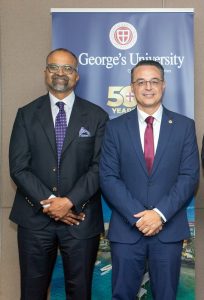
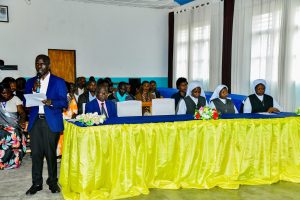
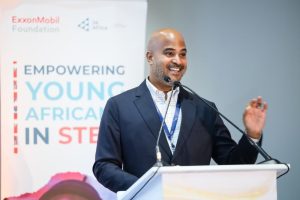
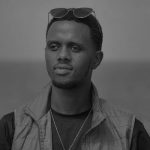
Dr. Sabin NSANZIMANA, the Minister of Health of Rwanda, at the Advancing Medical Education in Africa Conference on March 24, 2025.
Rwanda’s Minister of Health, Dr. Sabin NSANZIMANA, underscored the urgent need for a paradigm shift in the country’s healthcare approach, calling for significant reforms to better address the evolving nature of diseases and the disconnect between current medical education and real-world health challenges. He made these remarks during the opening of the two-day leadership conference, “Advancing Medical Education in Africa,” co-hosted by the University of Global Health Equity (UGHE) and Rwanda’s Ministry of Health, which kicked off on March 24, 2025.
In his address, Dr. NSANZIMANA reflected on the progress made in medical education in Rwanda but acknowledged the widening gap between education and the actual healthcare needs of the population.
“We’ve done so well as educators, as researchers, leaders, and politicians to make sure health education is prioritized to some extent. We have new medical schools, departments, and fellowship programs, but it’s not expanding as quickly as we would like,” he remarked. Despite these efforts, the demand for healthcare professionals continues to grow at an alarming rate, with hospitals facing overwhelming pressure to address both common and complex health issues.
He emphasized that Rwanda’s disease burden has shifted significantly over the past decade. “We moved from malaria, HIV, TB, and diarrhea being the main killers, to now dealing with non-communicable diseases like cancer, cardiac diseases, and renal diseases,” he stated. This shift, driven by increased life expectancy and lifestyle changes, calls for a major overhaul in medical training programs. The minister pointed out that the healthcare sector must evolve to meet these new demands, stressing the importance of bridging the gap between academia and real-world healthcare delivery.

One of the key areas highlighted by Dr. NSANZIMANA was the need for integrated medical education that connects clinical practice with academic learning. Drawing from personal experience, he shared the example of a health center in his village, where the nurse in charge was often called a doctor and performed complex surgeries due to a lack of qualified personnel. “The demand has gone up much more than before,” he said. “When the demand is there, we have to respond and connect the demand to the education system.” This connection, according to Dr. NSANZIMANA, requires a transformation in how medical schools and hospitals collaborate, with hospitals becoming central teaching hubs.
He also pointed out inefficiencies within the medical education system, such as the persistent separation between academic and clinical doctors. He revealed that, just a few years ago, a pediatrician might teach at a university but have limited clinical exposure, while a clinical pediatrician would work in hospitals with little involvement in teaching. To address this, Dr. NSANZIMANA called for the merging of academic and clinical roles, with hospitals becoming active teaching sites.
“Let’s transform our hospitals into classrooms as teaching areas,” he advocated. By aligning medical education with real-world clinical experience, Rwanda and Africa in general can produce healthcare professionals better equipped to serve the needs of the population.
“We are one team, serving the same people, same communities, serving ourselves,” Dr. NSANZIMANA added.
While Dr. NSANZIMANA acknowledged the progress made in expanding medical education, he noted that further innovations are required, particularly in leveraging new technologies. “The world is changing, and we must adapt,” he urged, highlighting the potential role of artificial intelligence (AI) in reshaping medical education and practice. AI and digital tools, he argued, could enhance learning and improve healthcare delivery, particularly in remote areas.
The Minister also called for a re-evaluation of current programs, urging stakeholders to design curricula that are in tune with the specific health needs of the country. “Before we create new faculties or residency programs, let’s first ask ourselves: What are the most important, most needed fields in our healthcare system?” he challenged the audience.

During an interview with the media, Prof. Philip Cotton, Vice Chancellor at the University of Global Health Equity (UGHE), emphasized the importance of integrating academic and clinical training.
“One of the problems students face is the disconnect between universities and the places where they really do their learning, which is in the community and in district hospitals,” Prof. Cotton said.
He proposed a more holistic approach to medical education, where students learn from a multidisciplinary team of healthcare professionals, including nurses, pharmacists, and physiotherapists. This, he argued, would provide a more comprehensive education and better prepare students for the challenges of real-world healthcare.
Prof. Cotton also highlighted the need for leadership within the healthcare education system to drive change.
“Some of the problems are easily fixed. Some of the problems are prolonged,” he said, urging leaders to take responsibility and ensure that changes are implemented swiftly. He invited attendees to embrace the conference’s transformative potential, calling on them to be agents of change and to make the necessary adjustments in the education system.

At the grassroots level, students are also calling for reforms. Benny Ines Bizimana, a second-year medical student at UGHE, shared her personal experience, emphasizing how the university has provided valuable support for students by offering scholarships and modern equipment. However, she also pointed out that the scarcity of medical schools remains a significant challenge.
“There are few universities, and they only take students with high marks, leaving some students without the opportunity to pursue medicine,” Bizimana noted.
She expressed hope that the conference would foster collaboration among medical students from different universities, enabling them to share knowledge and experiences.
The conference serves as a critical platform for dialogue on the future of medical education in Africa. With speakers like Dr. NSANZIMANA, and Prof. Cotton, it is clear that there is a collective call for innovation, collaboration, and bold leadership to address the pressing challenges facing the continent’s healthcare systems. As the conference continues, it is expected to yield actionable solutions that will transform medical education, ultimately ensuring that Africa’s healthcare workforce is ready to meet the evolving demands of the future.


About The Author

SUBSCRIBE TO OUR NEWSLETTER