Integrating Social Medicine: How UGHE is Transforming Medical Education in Africa

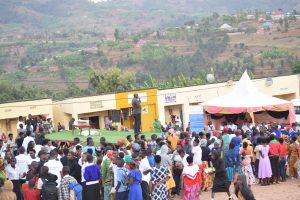
During the closing day of the Advancing Medical Education in Africa Conference, co-hosted by the University of Global Health Equity (UGHE) and Rwanda’s Ministry of Health on March 25, 2025, one of the notable sessions featured an interactive demonstration titled ‘Embracing Social Medicine in Medical Education.’ This session provided a compelling look at how UGHE integrates social medicine into its medical education through real-world community engagement.
Led by a team of UGHE medical students, faculty members, a community health worker, and a family from Butaro, the demonstration showcased the patient journey within the community. It emphasized the role of community health workers in addressing maternal and child health challenges, such as ensuring timely updates for pregnant women and their newborns.
The Power of Social Medicine in Practice
Dr. Fernet Léandre, Senior Lecturer in the Faculty of Global Health Delivery at UGHE, elaborated on the core principles behind this approach. “What you just saw is about some key concepts we teach in social medicine—shared mastery, humility, and accompaniment,” he stated.
He explained that UGHE’s competency-based curriculum ensures students learn from community health workers and directly engage with patients.
“We socialize care, focusing on the people we serve. The patient’s journey reveals critical social determinants—food insecurity, lack of transportation, education gaps—all of which impact health outcomes,” Dr. Léandre continued.
He stressed that UGHE students are trained not only to diagnose and treat diseases but also to understand the broader context of patients’ lives.
Sustaining Community Health Worker Motivation
One of the audience members raised a concern about sustaining the motivation of community health workers, particularly in terms of remuneration and government support.

Denys NDANGURURA, Lecturer in the Department of Community Health and Social Medicine at UGHE, responded: “In Rwanda, community health workers are elected by their communities, which builds trust. Historically, they filled the gap left by the genocide against the Tutsi, but the government is now considering moving from volunteer-based to paid community health workers. And I remember very well in the last election, even His Excellency, the President of Rwanda, Paul Kagame, ensured this time he would be the change in paying community health workers.”
While acknowledging financial constraints, NDANGURURA highlighted that community health workers receive performance-based financing and non-monetary incentives such as bicycles for hard-to-reach areas.
“Sustainability of this program requires leadership commitment, and at UGHE, community-based education is non-negotiable—it is a core component of our curriculum,” he emphasized.
Sandra ISANO, another lecturer in the same department, added: “These individuals do essential work and deserve to be compensated. While payment structures are evolving, we actively engage with community health workers, supporting their cooperatives and identifying sustainable ways to assist them beyond financial remuneration.”
Navigating Cultural Sensitivities in Community Engagement

An audience member posed a question about cultural sensitivities, noting how a large group of students visiting a home in Butaro might cause discomfort, particularly for patients dealing with conditions like HIV or pregnancy.

Jeanne MUKARURANGWA, a community health worker and UGHE faculty member reassured the audience: “Because of the trust we have built with the community, people understand that our visits are meant to find solutions together. We have not encountered resistance.”
Benithe HIMBAZWA, a fifth-year medical student at UGHE, further clarified: “We always seek consent before visits. Patients are informed in advance and have the choice to limit the number of visitors. This ensures they feel comfortable and respected.”
Dr. Léandre reinforced this point, emphasizing the role of trust. “Building trust with the community is foundational. Organizations that struggle with this often face resistance, but at UGHE and PIH, we prioritize trust-building, which allows us to integrate seamlessly into communities.”
Personal Encounters that Shape Future Doctors

Arnold TUYIZERE, another fifth-year medical student at UGHE, shared firsthand experiences that underscored the transformative impact of UGHE’s approach.
“We once visited an elderly patient with hypertension who was labeled ‘difficult’ because he wasn’t adhering to his medication. When we went to his home, we realized he had to walk over two hours to the health center. Even as future doctors, we would struggle to do that regularly. That visit changed our perspective on patient non-compliance.”
TUYIZERE also described assisting with deliveries at a district health center, where medical decisions had to be made without advanced technology. “In that moment, all our theoretical knowledge was put to the test. This experience gives us a deeper appreciation for the realities of healthcare in low-resource settings.”
The Posture of a Doctor: A Lesson in Humility

Closing the session, UGHE Vice Chancellor Prof. Philip Cotton left the audience with a profound reflection: “I want to leave you with one word—posture. Often, when we visit patients at home, we sit on the floor with them. Our curriculum is about dusty shoes and dirty fingernails.
Our posture—whether standing in solidarity or kneeling beside a patient—tells the story of our commitment to healthcare. It reflects our belief in those we serve. As students and graduates, we must continue to walk this journey with our patients, listening and learning as we go.”
A Transformative Model for Medical Education
The session reinforced UGHE’s unique approach to medical education, blending classroom learning with immersive community engagement. Through social medicine, students gain not only medical expertise but also the empathy and humility necessary to drive equitable healthcare solutions.
As UGHE continues to shape the next generation of health professionals, its model serves as an inspiration for medical education institutions worldwide. The integration of community-based learning ensures that future doctors not only treat diseases but also understand the social determinants affecting their patients’ lives—an approach that could redefine healthcare delivery across Africa and beyond.


About The Author


SUBSCRIBE TO OUR NEWSLETTER