How Rwanda Leads the Way in Restoring Degraded Farmlands with Tree-Based Solutions

One tree, many benefits; life, shelter, and hope
By Jean Claude HABIMANA
In today’s world, many people are worried about food shortages, rising temperatures, and the destruction of the environment. We hear sad news about floods, droughts, or hungry families yearly. But Rwanda is showing the world a different story of hope, action, and leadership. Rwanda is not just talking about change; it is making it happen. One of the strongest examples is how Rwanda uses trees to restore life to empty and damaged farmlands. This is called agroforestry, and even if it sounds like a big word, the idea is straightforward: farmers grow trees together with crops or animals.
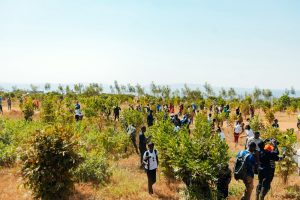
Agroforestry is not new. Our grandparents did it, and some still do. But what makes Rwanda special is that the country has made it a national goal. Leaders, farmers, researchers, media, and local people work together to bring trees back to the land. And the results are excellent. In many parts of the country, you will now see bananas growing next to trees, goats feeding under shaded areas, and fruit trees standing proudly in school gardens. This is not just beautiful; it’s powerful. Trees help the soil stay healthy, stop water from washing away, give shade to crops, and even provide food and firewood.
The world is now watching Rwanda. In 2025, Rwanda will host the World Congress on Agroforestry. This is a big international meeting where experts worldwide will come, share, and learn. Rwanda will not only welcome them, but it will also teach them. Because what is happening in Rwanda is proof that tree-based solutions work. For example, in the Western Province of Rwanda in the Sebeya catchment area, trees have been planted to restore life to damaged places. The government and its partners also work in the Eastern Province, Amayaga, Volcanoes, and Gicumbi, using trees to stop soil loss, halt biodiversity loss, protect water, give people jobs, and transform livelihoods toward sustainable development.
These are not small ideas. These are tangible actions that are already making life better.
What makes trees so important in farming is not just their beauty. Trees give more than one benefit at the same time. A mango tree, for example, offers fruits, provides shade, helps the soil, and can later be used for firewood. That means a farmer cannot choose between food and wood; they can have both. Trees also help fight climate change. They take in carbon dioxide, a gas that makes the Earth hotter, and they release oxygen. Trees are like silent workers. They do their job daily without making noise, but their impact is enormous.

With trees, land lives again
Trees help clean the air we breathe. One of the most significant problems today is the release of carbon dioxide (CO₂), especially from cars, factories, and firewood burning. This gas gets trapped in the sky and makes the Earth hotter. But trees help. Trees absorb CO₂ and store it inside their trunks and roots. This is called carbon sequestration. The more trees we plant, the more carbon we remove from the air. This helps slow down climate change and makes the air fresher and cleaner. That is why planting trees is not just a farm activity; it is a climate solution.
One of agroforestry’s most important but often ignored benefits is its role in protecting underground water. When the land is covered with trees and plants, rainwater does not simply run away. The roots of the trees help the water go down into the ground, where it stays and feeds underground water sources. This water is later used in wells, rivers, and springs. In dry areas like the Eastern Province, this is a lifeline. Without trees, rain washes away the soil and disappears. But with trees, water stays where people and animals need it the most.
Agroforestry also protects biodiversity. This means it keeps many plants, birds, insects, and animals alive. When we grow only one type of tree, like eucalyptus, we lose many living things that are part of our ecosystem. But many species can live and work together when trees, crops, and animals share the same land. Birds find places to nest, bees find flowers for honey, and animals find shade and food. This balance is essential. Every insect and plant plays a role in nature’s system. When we protect biodiversity, we protect our future.
Agroforestry does something even more profound: it restores harmony between people and nature. In many villages, people have started planting traditional medicinal trees again. These trees treat illnesses, just like their grandparents did. Others are planting trees that protect their land from strong winds and heavy rain. Farmers know their land better than anyone else, and agroforestry gives them the tools to take care of it. When farmers feel connected to their land, they work with more care and pride.
Trees are not just helpful for the environment. They are also part of our culture and identity. In Rwandan tradition, many trees have meaning. Some trees are planted to mark birth, to remember a loved one, or to celebrate peace. When we lose trees, we do not just lose wood or fruit; we lose our connection to who we are. Agroforestry helps bring back those cultural values. It teaches young people to care for the land, to respect what nature gives us, and to remember that trees are part of our family story.
Trees teach patience. You plant them, and you wait. They grow slowly but surely, the opposite of the fast and careless way some people treat nature today. Trees remind us that good things take time. They teach us to be responsible. They teach us to think of the next generation. When we plant trees, we are growing hope for ourselves, our children, and our grandchildren.
Rwanda has a big opportunity at the Congress in 2025. This event should be a place to show what we have done and a moment to demand more support from global partners. It should be a time to tell climate donors and international investors: “Support agroforestry not with small projects but with real money, real policies, and real plans.” The world spends billions on climate change. Let us make sure trees and agroforestry get their fair share.
Agroforestry is also about human dignity. It gives people hope and pride. When a farmer plants an avocado tree and knows her children will eat its fruit in the future, that is a powerful act. When a young person sees that he can earn a living from growing trees instead of leaving his village, that is a reason to stay. Agroforestry is not only about land. It is about people. It is about letting families have better lives while caring for nature.
However, not everything is perfect. There are still some problems. Some banks or businesses do not want to invest in tree-based farming because it takes time to see profits. But these are problems we can solve. We must support farmers, especially young people and women, with training, tools, and money.
We also need to teach children in schools about trees and how to care for the land. Agroforestry should not be seen as something old or for poor people. It is modern, innovative, and sustainable. It is a way of life that respects nature and supports people. We must change the way we talk about trees. They are not decorations. They are not something “extra.” Trees are the foundation of healthy land and strong communities.
Rwanda is leading the way not because it is the richest or biggest country, but because it believes in solutions that work for both people and nature. Rwanda is turning degraded land into living land, from Rusizi’s hills to Nyagatare’s plains, from home gardens to school farms. The goal is not just to plant trees but to grow a future.
I call on the world to look closely at Rwanda, not with charity, but with respect. Rwanda has shown that it is possible to restore the land, fight hunger, protect the climate, save water, and grow the economy, all at the same time. Let this World Agroforestry Congress be a turning point. Let the world see that the answer is not always in high technology or big machines. Sometimes, it is right under our feet, in the soil, in the seed, and in the roots of a tree. And Rwanda is standing tall like a tree for the world to see.
About the author: Habimana Jean Claude is the Science Communications Expert dedicated to unlocking the power of Nature-based Solutions, Forest Landscape Restoration, Conservation Agriculture, Sustainable Agriculture, Gene Editing, One Health, and the circular economy in Africa.
About The Author


SUBSCRIBE TO OUR NEWSLETTER