Gicumbi Farmers Reap the Benefits of Radical Terraces

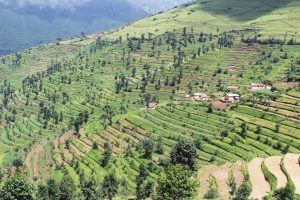
On the once-barren hillsides of Nyaruka Cell in Cyumba Sector, farmers are celebrating a dramatic turnaround in their livelihoods, thanks to radical terraces constructed by the Green Gicumbi Project. Where soil erosion once destroyed crops and stripped the land bare, the fields now yield bountiful harvests of beans, wheat, and Irish potatoes.
Local farmers say their agricultural output has more than tripled, attributing the success to the project’s climate-smart land management practices.

“In the past, this land was completely eroded. Water used to flow through our fields and wash away the soil. We had almost no yield,” said Jean Marie Vianney Minani, a 59-year-old farmer from Humura Village, Nyaruka Cell.
He added, “But since the radical terraces were built, everything has changed. We’ve been trained in crop rotation, and now we grow beans, wheat, and potatoes seasonally. From one hectare of wheat, we now harvest up to four tonnes.”
Minani says his earnings have skyrocketed to over 500,000 Rwandan Francs per harvest season. With the income, he has invested in livestock and improved his family’s quality of life. “Now I have cows, goats, and sheep. My children are studying, and we are living well.”
The transformation is the result of the Green Gicumbi Project—officially known as Strengthening Climate Resilience of Rural Communities in Northern Rwanda. Launched in 2019, the six-year, $32 million initiative is funded by the Green Climate Fund (GCF) and implemented by the Rwanda Green Fund (FONERWA).
The project aims to build resilience among rural populations vulnerable to climate change. In Gicumbi District, the project has worked closely with local residents to reclaim degraded land and enhance agricultural productivity.
In Nyaruka Cell alone, 40 hectares of radical terraces have been established. The land now supports a rotation of cereals and pulses, while agroforestry species such as Calliandra and Leucaena help stabilize the soil and provide fodder for livestock.

Another beneficiary, Vestine Nyiransekuye, shared her story of transformation: “Before the project, I was living in poverty in a dangerous zone. Today, I own a house worth seven million Rwandan Francs, and my children are in school.”
She added, “I used to grow two sacks of beans per season—just 200 kilograms. Now, I harvest up to 1.5 tonnes. My Irish potato yield is also increasing steadily. Last season, I sold 1.5 tonnes, and I expect 2 tonnes in the next. For wheat, before it was less than 100 kgs; now it is 600 kgs or 700 kgs.”

Jean Marie Vianney Kagenza, the Green Gicumbi Project Coordinator, said the terraces have not only increased yields but also improved the resilience of the land and local communities.
“We are already seeing three- to fourfold increases in production,” Kagenza said. “Our goal is to multiply that tenfold. These terraces control erosion, retain soil nutrients, and help withstand drought.”
Beyond yields, Kagenza emphasized a shift in environmental awareness among residents. “The most encouraging part is seeing people recognize their role in combating climate change and protecting the environment.”

Gicumbi District Mayor Emmanuel Nzabonimpa confirmed that the impact is district-wide. “Through this project, we’ve built 600 hectares of radical terraces and 850 hectares of progressive terraces,” he said. “As a result, maize production has increased by 20%, beans by 28%, potatoes by 23%, and wheat by 11% per hectare.”
Mayor Nzabonimpa expressed hope that the project will be scaled across all 21 sectors of Gicumbi, and even replicated in neighboring districts such as Gakenke.
The Green Gicumbi Project currently operates in nine sectors—Rubaya, Cyumba, Kaniga, Mukarange, Rushaki, Shangasha, Manyagiro, Byumba, and Bwisige—impacting around 252 villages. It targets 150,000 direct beneficiaries and another 380,000 indirect beneficiaries, making it one of Rwanda’s most ambitious climate adaptation programs to date.
As farmers in Nyaruka Cell continue to thrive, their success stands as a model for sustainable agriculture in the face of climate change.


About The Author


SUBSCRIBE TO OUR NEWSLETTER