Rwanda Hosts the African Olympiad Academy to Nurture the Continent’s Future Innovators

Rwanda has welcomed the African Olympiad Academy (AOA), a Pan-African residential high school dedicated to nurturing the continent’s brightest minds in mathematics, science, and problem-solving. The academy aims to develop world-class innovators and leaders who remain grounded in African culture and driven by a strong sense of purpose.
AOA opened its doors in September at its Kanombe campus in Kigali, admitting its first cohort of 30 students from eight African countries including Namibia, Kenya, Nigeria, Botswana, Rwanda, South Africa, Tanzania and Uganda. The academy was officially launched on November 19, 2025.
The school offers a three-year Cambridge curriculum for boys and girls aged 14-19 on 100% scholarships for all students.
It also provides an online learning program called Rising Stars, which allows students who cannot join the campus physically to participate in selected training sessions in both English and French.
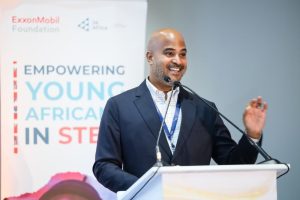
Gaidi Faraj, co-founder and Head of School, explained that the idea behind the African Olympiad Academy was inspired by sports academies that rigorously train young athletes to reach professional levels.
“We wanted to build an academy that trains students just as rigorously—but in mathematics, physics, and computer science—to develop the next generation of STEM talent. This is incredibly important in the age of AI; otherwise, Africa risks being left behind,” he said.

“We need people who are writing theorems and developing new algorithms. Our goal is to train that generation so that Africa can lead, rather than simply copy from the West. That is the vision of AOA.”
He added that the Rwanda Olympiad Foundation has already made a significant impact on mathematics education in the country whereby Rwandan students have excelled in national and international competitions, including the Rwanda Mathematics Competition, the Pan-African Mathematics Olympiad, the International Mathematical Olympiad, the International Olympiad in Informatics, and the International Olympiad in AI, throughout the 2024–2025 academic year.
“When students perform well, it opens doors for scholarships and opportunities to study abroad. But we also instill in them a deep sense of responsibility to Africa. Wherever they study, they remain committed to contributing to their home countries and to the continent.”
Arun Shanmuganathan, co-founder and Executive Director, emphasized that the academy prepares students not only through rigorous academics but also by engaging them in international competitions such as the International Mathematical Olympiad and the Pan-African Mathematics Olympiad.

“We train these students comprehensively in math, science, and the social sciences and support them as they represent their national teams in global competitions before joining top universities around the world,” he said. He added that the academy plans to expand gradually to include more students from across the continent.
Eraste Rurangwa, Permanent Secretary at MINICT, described the academy’s mission as central to Africa’s development agenda.
“This is not a side project. It aligns perfectly with Rwanda’s belief that our greatest untapped resource is not underground but in the minds of our young people,” he said.

He expressed the government’s readiness to collaborate with AOA to support its scholars and to scale its effective teaching methods across the country.
Addressing the students, he added, “The country is counting on you to become tomorrow’s problem solvers, innovators, and leaders.”
Seventeen-year-old Rwandan student Sonia Keza believes AOA will help African learners unlock their potential.
“At school, we didn’t have enough time to focus on Olympiad mathematics,” she said. “Here at AOA, we have the time and support to practice deeply. I have realized that the problem was not that Rwandans or Africans in general are not talented, but rather we don’t get the opportunity to train our minds.”
Prince Phenyo Sokwe from Botswana said he expects to graduate from the academy with a wealth of knowledge that will prove Africa belongs in the global STEM arena.
“One thing that the school always says is that we are problem solvers. I hope to solve a lot of problems with all the knowledge I gain. Being part of this school has already opened many doors, and I want to use those opportunities to help build a better future for Africa and for my country”, he said.


About The Author


SUBSCRIBE TO OUR NEWSLETTER