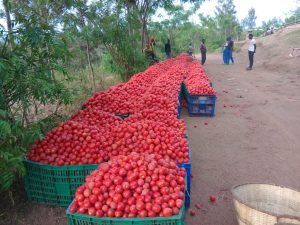
How Agricultural Insurance Is Helping Kamonyi Farmers Rebuild After Climate Losses

For years, unpredictable weather pushed farmers in Kamonyi District under growing pressure, wiping out harvests and livestock and threatening livelihoods built over decades. Today, many say agricultural insurance has become a turning point, helping them recover from costly losses and farm with renewed confidence.
The campaign to mobilize farmers to enroll in the National Agriculture Insurance Scheme (NAIS) is currently underway in the Southern Province, including Kamonyi, where Rwanda Agriculture and Animal Resources Development Board (RAB) officials are working with local authorities to raise awareness about the program’s benefits.
Marie Louise Mukansanga, a treasurer at IMPABARUTA Cooperative, knows this reality all too well. The cooperative cultivates maize on 60 hectares in Rwabashyashya Marshland, an investment that runs into hundreds of millions of francs.

“We joined the Tekana Urishingiwe Muhinzi-Mworozi program in 2019, but before that, we had suffered huge losses,” Mukansanga said.
She recalled the 2017 farming season as one of the most devastating periods for the cooperative. Heavy rainfall, strong winds and hailstorms flattened their maize fields.
“That year, we expected to harvest about 180 tonnes, but we only got 70 tonnes,” she explained. “The entire marshland was affected. We had no insurance, so the loss was entirely ours.”
Insurance as a Safety Net for Large Investments
The experience pushed the cooperative to rethink risk management. In 2019, IMPABARUTA enrolled in the National Agriculture Insurance Scheme (NAIS), locally known as Tekana Urishingiwe Muhinzi-Mworozi.
The decision proved crucial when disaster struck again in 2023.

“We faced strong winds once more, and the maize fell,” Mukansanga said. “This time, we harvested 230 tonnes instead of the expected 294. But because we were insured, the losses were compensated.”
For the cooperative, insurance is no longer optional.
“We have invested over Rwf 200 million here,” she added. “Putting such money into farming without insurance, especially when the government even subsidizes it, would be a serious mistake.”
Livestock Farmers Find Peace of Mind
The benefits of agricultural insurance are also being felt beyond crop farming. In Runda Sector, cattle farmer Bernadette Nyiranshimimana says joining Tekana brought peace of mind after painful losses.

“I lost two cows before I had insurance,” she said. “That experience showed me how vulnerable livestock farmers are.”
She later insured all her cattle under the scheme.
“Tekana gives peace to any farmer, whether you keep small or large livestock,” Nyiranshimimana said. “If you follow professional farming practices, feeding well, treating animals on time, and insurance will compensate you when a disaster happens.”
Opening Doors to Finance and Growth

According to Kamonyi District Mayor, Dr. Sylvere Nahayo, agricultural insurance is not just about compensation, it is also changing how farmers are perceived by financial institutions.
“Insuring crops and livestock builds credibility,” he said. “Farmers with insured activities are more likely to access loans from banks and financial institutions, allowing them to expand and modernize their operations.”
Dr. Nahayo noted that farmers who have already received compensation are now playing a key role in mobilizing others.
“They share real experiences of how insurance companies paid them after disasters. That testimony is powerful, and we are seeing encouraging results.”
However, challenges remain.
“Limited awareness and misconceptions among some farmers still exist,” he said, adding that the district continues outreach efforts in collaboration with farmers already enrolled in the Tekana program.

Insurance uptake in Kamonyi District has steadily increased. Currently, 46.5 percent of cattle farming is insured, while poultry and maize production have reached full insurance coverage. About 80 percent of pig farming is insured, and 330 hectares of rice fields are covered out of a targeted 760 hectares.
A National Effort to Protect Farmers
Launched in 2019 by the Ministry of Agriculture and Animal Resources (MINAGRI), the National Agriculture Insurance Scheme (NAIS) is implemented by the Rwanda Agriculture and Animal Resources Development Board (RAB) through its Single Project Implementation Unit, in partnership with private insurance companies.
To make the scheme affordable, the government subsidizes 40 percent of insurance premiums for smallholder farmers.
Since its launch, NAIS has insured about 189,734 farmers and livestock keepers, representing roughly six percent of Rwanda’s farming population. The government has invested Rwf 5.95 billion in premium subsidies, while Rwf 8.19 billion has been paid out in compensation, Rwf 3.57 billion for livestock and Rwf 4.62 billion for crops.
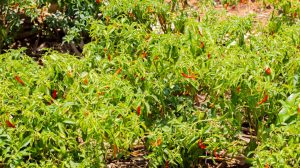
The scheme covers key crops including rice, maize, potatoes, beans, chili, soybeans, French beans, and cassava, as well as livestock such as cattle, pigs, poultry, and fish.


About The Author


SUBSCRIBE TO OUR NEWSLETTER