Agricultural Impact Report: Five Ways KIIWP Transforms Agriculture in Kayonza, Rwanda

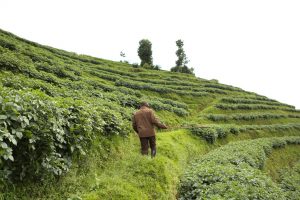
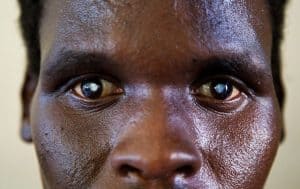
Munyabugingo Sylvere, a farmer in Mukarange Sector, Kayonza District
1. Project Profile and Strategic Geographic Scope
The Kayonza Irrigation and Integrated Watershed Management Project – Phase II (KIIWP2) is a flagship initiative of the Government of Rwanda, implemented by the Rwanda Agriculture and Animal Resources Development Board (RAB) in strategic partnership with the International Fund for Agricultural Development (IFAD).
Moving beyond the emergency drought responses of the past, KIIWP2 is currently in its second phase (2022–2028), scaling up the foundational investments made during Phase I (2019–2024). The project is specifically engineered to transition Kayonza’s agriculture into a climate-resilient and market-oriented sector. The intervention targets nine drought-prone sectors within the Kayonza District: Gahini, Kabare, Kabarondo, Murama, Murundi, Mwiri, Ndego, Ruramira, and Rwinkwavu.
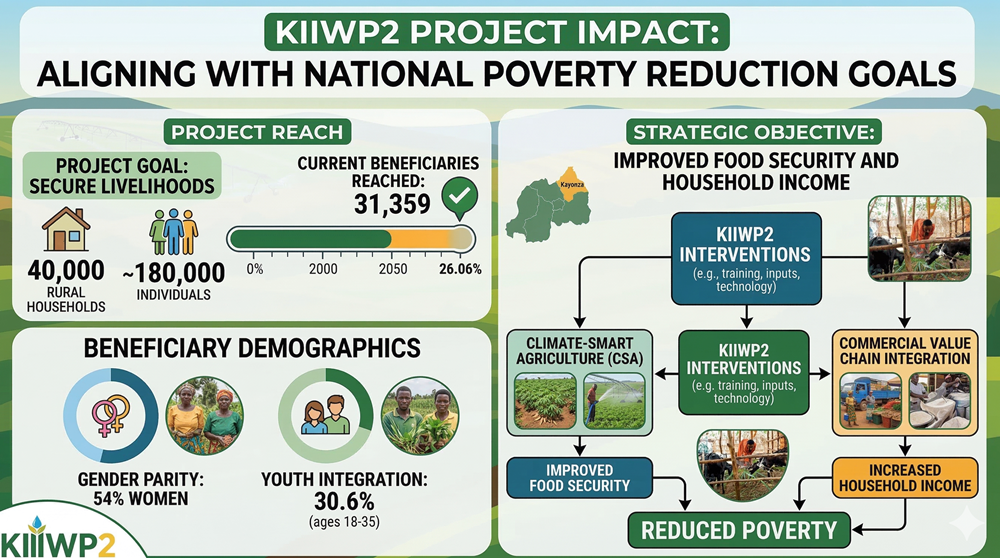
Beneficiary Reach and Inclusivity Metrics
The project aligns with national poverty reduction goals, aiming to secure the livelihoods of 40,000 rural households (approximately 180,000 individuals).
- Current Beneficiaries Reached: 31,359
- Gender Parity: 54% Women
- Youth Integration: 30.6%
- Strategic Objective: Improved food security and household income through Climate-Smart Agriculture (CSA) and commercial value chain integration.
2. Transformation 1: Climate-Resilient Water Infrastructure and Irrigation
To mitigate the volatility of rain-fed systems, KIIWP2 is deploying permanent water management infrastructure. This technical shift ensures that agricultural cycles are no longer dictated by unpredictable precipitation patterns, particularly in the historically water-scarce Eastern Province.
The Gishanda Dam Project
A central pillar of this transformation is the construction of the Gishanda Dam. With a total investment of 2.1 billion RWF, this ongoing project is scheduled for commissioning in June 2026. The technical design encompasses four integrated components:
- Dam Construction: Creating a reliable primary water source.
- Pump Station: Facilitating efficient water distribution.
- Irrigation Network: Direct delivery to farm plots.
- Water Reservoir: Ensuring storage capacity for dry-season stability.
The dam is engineered to provide year-round irrigation for 200 hectares across the Kabare and Rwinkwavu sectors. Complementing this major installation, the project has already rehabilitated 15 valley dams and installed 20 boreholes, providing a dual-service solution for livestock hydration and clean domestic water.
Papias Ngaboyamahina, a technical professional at ASSETIP, noted: “This major infrastructure is part of efforts to provide long-term irrigation solutions for farmers who have struggled for years with water scarcity.”
3. Transformation 2: Climate-Smart Land Husbandry and Soil Conservation
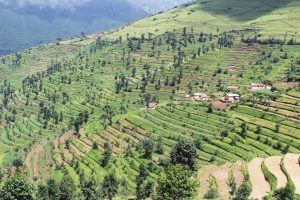
In rain-fed areas, the project employs Climate-Smart Agriculture (CSA) to combat severe soil erosion and nutrient depletion. Through radical terracing and the strategic planting of elephant grass along contour lines, KIIWP2 has stabilized slopes that were previously uncultivable.
Notably, the elephant grass serves a technical dual purpose: it acts as a mechanical barrier for soil stabilization and provides a critical source of high-quality fodder for livestock, directly linking land husbandry to animal productivity.
Land Husbandry Implementation Status
The project is making significant progress toward its 1,950-hectare target for rain-fed areas.
| Metric | Target Hectares (ha) | Completed Hectares (ha) | Implementation Rate (%) |
| Land Husbandry Development | 1,950 | 1,246 | 63.9% |
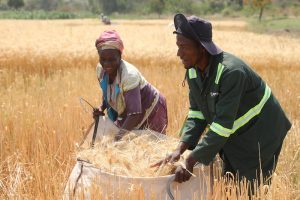
Evidence of Impact: Ndego Sector The transformation in Ndego highlights the effectiveness of these interventions. Before the project, soil run-off was so severe that maize yields averaged less than 50 kg per hectare. Following terracing and seed distribution, productivity has surged to 2 tonnes per hectare.
Vincent Ndahimana, president of the Duhuze Imbaraga farmers’ group, testified: “The terraces stop the water from running off with our soil… My children go to school, and I can pay for their community health insurance. This is the third year since the terraces were built, and we now farm with confidence.”
4. Transformation 3: Commercialization via High-Value Value Chains
In alignment with the Strategic Plan for Agricultural Transformation (PSTA 5), KIIWP2 is driving a mindset shift from subsistence to commercial horticulture. The project has established a massive 1,300-hectare fruit orchard across Kabarondo, Murama, and the Remera Sector of Ngoma District. This orchard specializes in export-ready avocados, mangoes, and citrus fruits.
Market Integration and FARM P3
To ensure these yields translate into sustainable income, KIIWP2 is integrated with the FARM P3 project. This initiative focuses on reducing post-harvest losses and establishing formal market linkages with private-sector leaders such as Africa Improved Foods (AIF). Technical analyses suggest that by adopting these high-value practices and stable market linkages, soybean producers could see their incomes increase by up to 2.3 times over five years.
Alphonsine Nyirahategekimana, a local governance official and farmer in Rwinkwavu, explained the shift: “Once we saw how fruit farming generates income, we understood that with money earned, one can buy other food and improve living standards.”
5. Transformation 4: Socio-Economic Empowerment through the GALS Approach
RAB recognizes that technical gains are only sustainable if paired with social justice. KIIWP2 utilizes the Gender Action Learning System (GALS), a community-led methodology that uses visual tools to address household dynamics and shared decision-making.
Strategic Social Outcomes:
- Training Reach: 16,000 community members and village leaders trained.
- Legal Security: Approximately 500 couples have formalized their marriages.
- Technical Relevance: In the Rwandan context, legal marriage is a prerequisite for secure land rights. By formalizing these unions, the project provides women with legal security, which incentivizes long-term investment in soil health and household infrastructure.
Syriaque Nganji, a resident of Ruramira, shared the impact: “I learned to respect [my wife], save money… We’ve now reached a good level and continue progressing. We live in harmony.”
6. Transformation 5: Cooperative Empowerment and Diversified Livelihoods
KIIWP2 strengthens grassroots cooperatives by shifting them toward self-sustaining business models. A key technical mechanism is the 70/30 matching grant, where the project covers 70% of investment costs, and the cooperative contributes 30%. This ensures local ownership and fiscal responsibility.
Diversification and Infrastructure:
- Nutritional Security: Cooperatives are now engaged in sweet potato vine multiplication, which serves as a “new weapon against hunger” while providing a marketable product.
- Environmental Entrepreneurship: The Environmental Conservation Cooperative (ECC) leverages project support to produce agroforestry and fruit seedlings, blending conservation with profit.
- Post-Harvest Resilience: To bridge the gap between production and the market, RAB is overseeing the construction of 55 storage facilities, 4 mechanical dryers, 3 small processing plants, and dedicated fruit packhouses.
7. Summary of Results and Future Outlook
The transition from “traditional” to “professional” agriculture in Kayonza is best evidenced by the “hero metric” from the Buhabwa Milk Collection Centre. Due to improved water access and fodder availability (from elephant grass), milk intake during the dry season has risen from 3,000 liters to 12,000 liters—a fourfold increase that proves the system’s resilience to climate shocks.
Critical Takeaways for Rwanda’s Agricultural Future:
- Water Security as a Foundation: Large-scale infrastructure like the Gishanda Dam is the non-negotiable prerequisite for stabilizing yields in drought-prone regions.
- Integration of Social and Technical Systems: The success of the GALS approach demonstrates that addressing household gender dynamics and legal land security is as vital as distributing seeds.
- Market-Led Infrastructure: The transition to commercial farming is only viable when supported by a robust post-harvest network (dryers, storage, and processing) that connects smallholders to high-value buyers like AIF.
About The Author


SUBSCRIBE TO OUR NEWSLETTER