Rwanda Advances Decade-Long Sustainable Finance Drive as Roadmap Hits Midpoint

KIGALI — Rwanda is pressing ahead with its 10-year plan to become a leading African hub for green and sustainable investment, as officials move from strategy into implementation with a new green taxonomy, digital tools, and a broader financial-sector overhaul now underway.
The Sustainable Finance Roadmap, launched in 2022 and running through 2032, set out to build the instruments, market infrastructure and skills needed to attract local, regional and international capital for climate-resilient and socially inclusive projects. Four years on, the government and the Kigali International Financial Centre have begun a mid-term review of progress so far and are rolling out the practical tools the plan called for.
A central piece arrived last year. In September 2025 Rwanda launched the implementation roadmap for its Green Taxonomy together with a digital platform, the Rwanda Green Taxonomy Navigator. The taxonomy, adopted by Cabinet in April 2025, defines which activities count as green across key sectors including agriculture, energy, construction and transport. Officials say it gives investors clearer rules, reduces the risk of greenwashing and channels money toward national climate and development targets.
“The launch of this implementation roadmap and the digital tool marks a pivotal moment for Rwanda’s sustainable finance landscape,” Herbert Asiimwe, head of the Financial Development Department, said at the time. “The Taxonomy provides the needed clarity and confidence to channel capital towards our national priorities.”
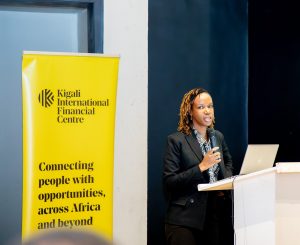
Hortense Mudenge, chief executive of Rwanda Finance and the Kigali International Financial Centre, called it a transformative step. “The taxonomy strengthens our value proposition as a trusted jurisdiction for sustainable investments. It enhances our ability to attract climate-conscious investors, fosters innovation in green financial products, and reinforces our commitment to building a thriving, transparent, and future-proof financial ecosystem.”
The original roadmap had identified a national taxonomy as a priority. Rwanda became the second country in Africa to adopt one and the first to include agriculture from the outset.
Alongside the taxonomy, the government unveiled the Financial Sector Development Strategy 2025–2030 in October 2025. The strategy treats sustainable finance as a core theme, calling for blended-finance structures, more sustainability-linked bonds, a green credit guarantee scheme and a stronger pipeline of climate and nature projects. It also aims to deepen Kigali’s role as a regional financial centre.
Earlier supporting measures include a 2024 Sustainable Finance Framework that sets rules for green, social and sustainability bonds and loans. That framework has already been used to back international financing for eligible projects. Banks now operate under new ESG guidelines, and sustainability disclosure rules aligned with international standards are being phased in.
A mid-term review of the 2022–2032 roadmap, covering the first phase through 2025, was commissioned in early 2026. Officials say early results include the taxonomy and implementation plan, stronger ESG reporting standards and training programmes across the financial sector. The review is expected to identify bottlenecks and adjust priorities for the second half of the decade.
The wider effort sits inside Rwanda’s push for upper-middle-income status by 2035 and high-income status by 2050. Planners argue that mobilising private capital for renewable energy, climate-smart agriculture, landscape restoration and social infrastructure is essential if public budgets alone cannot close the gap.
Market activity is beginning to follow the policy. Development banks have issued sustainability-linked bonds, blended-finance facilities targeting smallholders and rural businesses have been announced, and Kigali continues to host investor events aimed at linking African projects with international capital.
Challenges remain. Officials acknowledge the need for more bankable projects, deeper local capital markets, and skilled professionals who can structure and assess sustainable deals. The mid-term review is intended to sharpen those efforts.
For now, Rwanda is presenting the combination of a clear taxonomy, digital tools, updated sector strategy and an active financial centre as evidence that the 2022 vision is moving from paper into the market. The next test will be whether the review produces concrete course corrections and whether private capital follows the new rules at scale.
About The Author


SUBSCRIBE TO OUR NEWSLETTER