Rwanda’s stakeholders join forces to accelerate Education for Sustainable Development before 2030
With four years left to the 2030 deadline, government, partners, civil society, universities and schools took stock of Rwanda’s Education for Sustainable Development roadmap and agreed on who does what next.
KIGALI, 5 November 2026: Rwanda’s education and environment stakeholders met in Kigali on Thursday and renewed their commitment to speed up sustainability education. They agreed to build on the country’s strong progress and turn shared plans into measurable results before 2030.
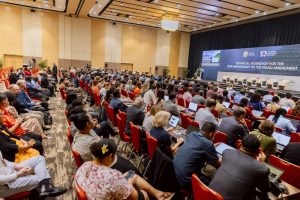
More than 70 participants from government, United Nations agencies, development partners, civil society, universities and schools attended the National Education for Sustainable Development (ESD) Stakeholders Dialogue at the Marriott Hotel. The Rwanda Basic Education Board (REB), the Rwanda National Commission for UNESCO and the Albertine Rift Conservation Society (ARCOS) jointly organised the meeting.
Under the theme “Synergies to accelerate actions of the country initiative for 2030,” the dialogue celebrated progress on Rwanda’s ESD for 2030 country initiative and charted the next phase to 2030.
Eng. Pascal Gatabazi, Chief Technical Advisor to the Minister of Education, officially opened the dialogue on behalf of the Minister. He said sustainability should become part of what learners are taught, how they are taught and how institutions operate.
“Our schools, TVET institutions, and higher learning institutions should become centres where sustainability is not merely discussed but demonstrated through everyday learning and practice,” Gatabazi said. “Education for Sustainable Development is not the responsibility of the Ministry of Education alone. It requires a whole-of-government and whole-of-society approach.”
Dr. Sam Kanyamibwa, CEO and Founder of ARCOS, invited participants to consider the legacy they want to leave.
“What kind of world and Rwanda are we preparing future generations to inherit, and what kind of generation are we preparing to lead it?” he asked.
He cited the World Bank’s recent report Choosing Our Future: Education for Climate Action, which identifies education as one of the most powerful tools for climate action.
“This is precisely why Education for Sustainable Development is not optional; it is essential to building resilient communities and a sustainable future,” Kanyamibwa said. “The time for planning alone has passed. We must now focus on implementation and measurable results.”
He praised the expertise and commitment that already exist across Rwanda’s institutions. By working more closely together, he said, partners can turn individual efforts into collective impact, awareness into action, and commitments into accountability.
Albert Mutesa, Secretary General of the Rwanda National Commission for UNESCO, placed the country’s efforts within UNESCO’s ESD for 2030 framework and the Greening Education Partnership. He said Rwanda’s national roadmap and coordination mechanisms have given it a solid foundation to build on.
“Achieving our 2030 ambitions requires stronger partnerships, effective coordination, resource mobilization, and collective accountability,” Mutesa said.
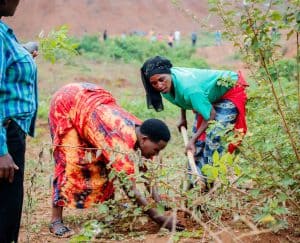
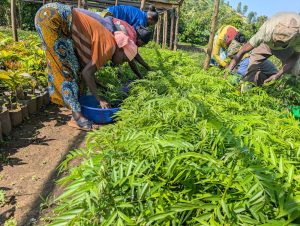
He described schools as centres of sustainability, where learners turn knowledge into action through tree planting, biodiversity conservation, waste management and climate initiatives. He also described young people as essential partners and agents of change.
“Let us remember that sustainable development begins with what we teach, what we value, and what we practice,” he said.
Fixer Eugene Ngoga, Director of School Leadership, Career Guidance and Counselling at REB and Rwanda’s National ESD Focal Person, presented the progress of the country initiative. It covers five priority areas: policy, learning environments, educator capacity, youth engagement and local-level action. A national Core Team coordinates it, bringing together REB, the Ministry of Environment, the Rwanda National Commission for UNESCO, REMA, the National Youth Council, universities and civil society organisations including ARCOS.
The results are encouraging. According to REB, 2,293 teachers have been trained and 109 schools, including teacher training colleges, are engaged. Some 69,259 students are actively taking part. More than 100,000 trees have been planted through ESD-related action, and over 80 climate-smart micro-projects have been funded. Notably, 59 per cent of students have carried ESD practices home to their households.
Looking ahead, Ngoga set out a clear path to scale up these gains. It includes updating the policy base with a costed finance plan, setting baselines to track progress, and publishing an annual progress report aligned to SDG target 4.7. It also includes expanding Eco-Schools, environmental clubs and youth networks to every district.
“Our progress towards 2030 depends on how effectively we work together,” Ngoga said. “Let us unite our efforts, strengthen partnerships and turn shared commitments into practical action.”
Prof. Irene Ndayambaje, Dean of the Faculty of Education at the University of Rwanda College of Education and National Coordinator of LEAD-ESD, showed how the project is building ESD capacity among teachers in teacher training colleges and TVET institutions.
The dialogue also highlighted ARCOS’ Eco-Schools programme as a practical way to advance SDG 4 on quality education, SDG 12 on responsible consumption and production, and SDG 13 on climate action. The initiative showed how participating schools are becoming hubs of sustainability, where learners gain hands-on skills in conservation, ecosystem restoration and waste management.
Commitments for 2027–2030
Participants aligned the 2027–2030 roadmap with UNESCO’s five priority areas, assigning responsibilities, timelines and budgets. Recommendations were then agreed in plenary.
The dialogue closed with a shared pledge from all participants: to measure its success not by the quality of the discussions, but by the actions taken afterwards and their impact on future generations.
About The Author


SUBSCRIBE TO OUR NEWSLETTER