Kigali Marks 10 Years of Kigali Amendment as Global Leaders Call for Energy-Efficient Cooling
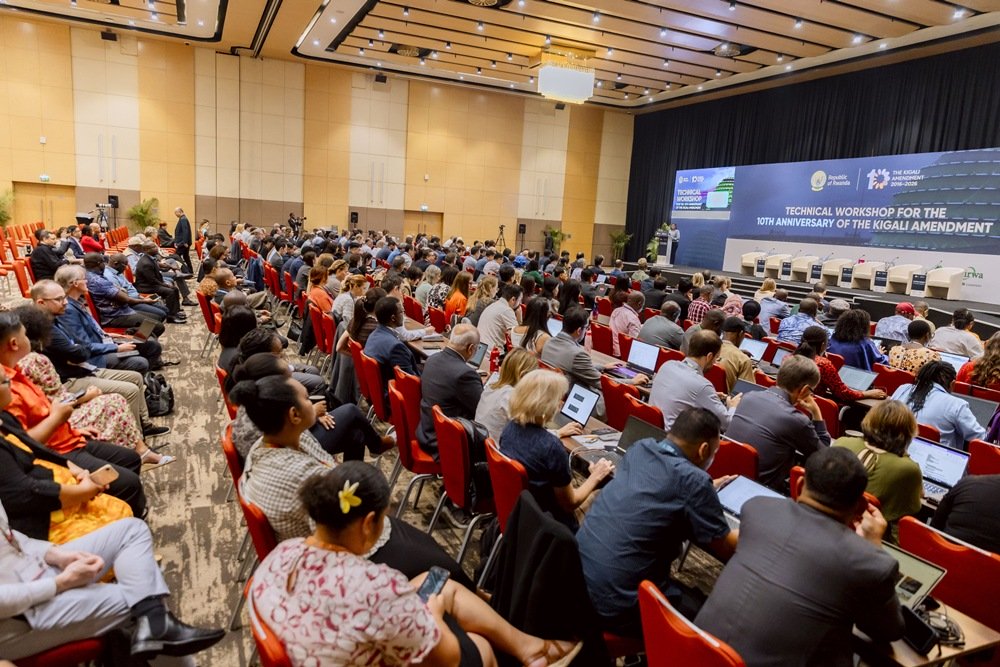
KIGALI, Rwanda – Global climate leaders, government officials, technical experts and industry representatives have gathered in Kigali to mark the 10th anniversary of the Kigali Amendment to the Montreal Protocol, calling for stronger implementation measures that combine the phase-down of climate-warming refrigerants with improvements in energy efficiency.
The high-level technical workshop, held ahead of the 38th Meeting of the Parties (MOP 38), provides an opportunity to assess a decade of progress since the landmark agreement was adopted in October 2016 and identify priorities for the next phase of global climate action.
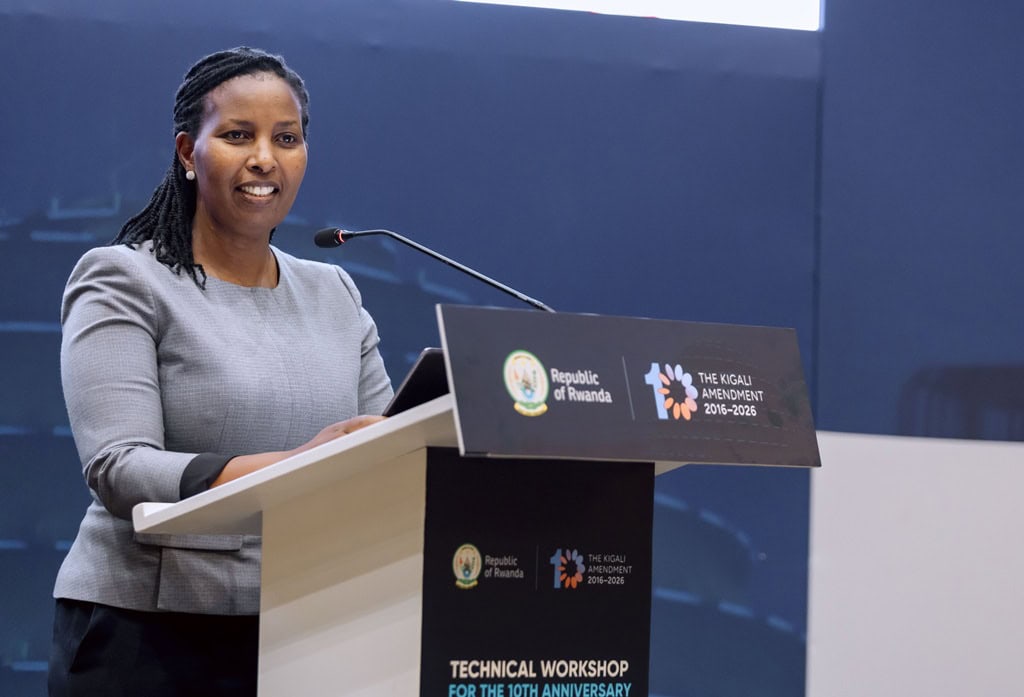
Opening the proceedings, Juliet Kabera, Director General of the Rwanda Environment Management Authority (REMA), said the coming decade must move beyond international commitments towards practical implementation, particularly in developing countries.
She recalled the diplomatic efforts that led to the adoption of the amendment, emphasizing that its success now depends on translating global agreements into measurable results on the ground.
Rwanda’s Minister of Infrastructure, Eng. Damien Murwanashyaka, called on countries to expand their climate ambitions beyond reducing hydrofluorocarbons (HFCs), emphasizing that replacing refrigerants without improving the energy performance of cooling equipment would leave a significant part of the sector’s environmental impact unaddressed.
Murwanashyaka noted that refrigerators and air conditioners consume electricity throughout their operational lives, meaning their indirect emissions from power consumption can exceed the direct emissions associated with refrigerant leakage.
“An air conditioner or refrigerator may contain refrigerant for the duration of its operating life, but it consumes electricity every day,” he said, explaining that changing the gas while leaving equipment inefficient would address only part of the problem.
The workshop highlighted the importance of combining refrigerant transitions with minimum energy performance standards, sustainable cooling technologies and improved electricity infrastructure.
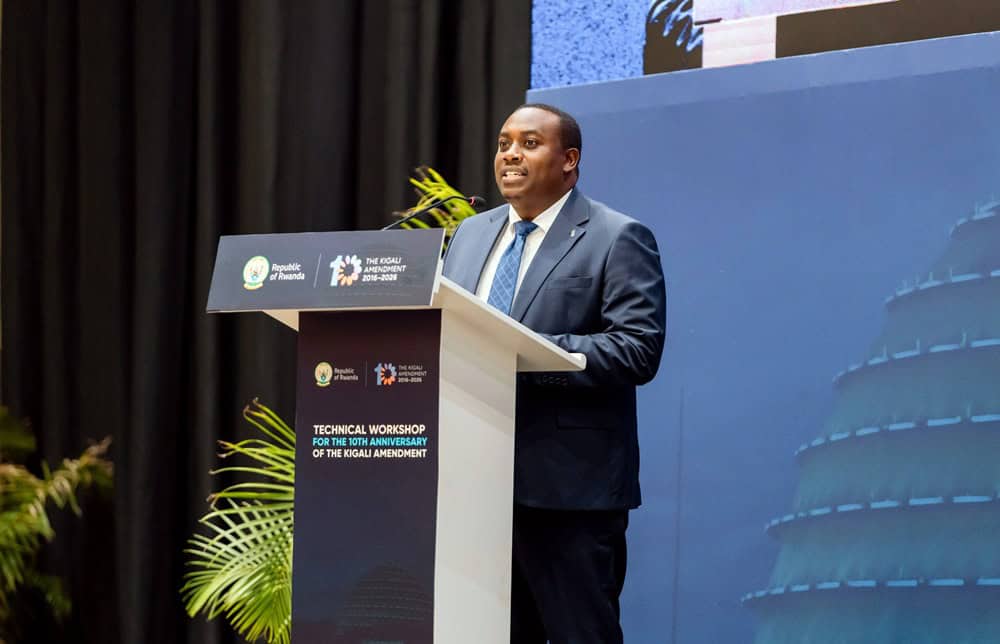
Rwanda’s Minister of Infrastructure, Eng. Damien Murwanashyaka
According to figures presented during the discussions, direct refrigerant emissions account for approximately one-third of the climate impact of cooling equipment, while electricity consumption contributes the remaining two-thirds.
The HFC phase-down alone is projected to prevent 1.1 billion tonnes of carbon dioxide equivalent emissions by 2050. Combining it with energy efficiency improvements could deliver an additional 2.2 billion tonnes in avoided emissions.
The Kigali Amendment has so far secured ratification from 175 of the 198 parties to the Montreal Protocol. Its full implementation is projected to avoid more than 80 billion tonnes of carbon dioxide equivalent emissions by 2050 and help prevent up to 0.5°C of global temperature rise by the end of the century.
By 2025, global HFC consumption was approximately 15% below baseline levels, while production had declined by 34%. Developed countries recorded deeper reductions, with consumption 56% below baseline and production 72% lower. Developing countries in Article 5 Group 1 had achieved reductions of approximately 36% to 37% in both consumption and production.
However, participants cautioned that the transition remains uneven, particularly in developing economies where access to affordable and energy-efficient cooling equipment is still limited.
Africa faces a significant cooling challenge
For African countries, sustainable cooling is increasingly regarded as essential infrastructure rather than a luxury. Refrigeration supports food preservation, agricultural supply chains, vaccine storage, pharmaceutical distribution and productivity in workplaces exposed to rising temperatures.
Yet the continent continues to face regulatory and technological gaps that could undermine the benefits of the global refrigerant transition.
Workshop discussions indicated that mandatory minimum energy performance standards cover approximately 89% of global room air conditioner energy use, compared with only 50% in Africa.
The disparity raises concerns that developing markets could become destinations for inefficient cooling equipment as international manufacturers shift towards more advanced technologies.
Rwanda is positioning itself as part of the response through the Africa Centre of Excellence for Sustainable Cooling and Cold Chain (ACES), which works with international and academic partners to promote technology demonstrations, technician training and research into sustainable cold-chain systems.
Other initiatives discussed included the Safe Sustainable Cooling for Africa Initiative, launched in Cabo Verde in 2026 with support from UNEP OzonAction and the Multilateral Fund. The programme integrates occupational health and safety into refrigeration and air-conditioning servicing, particularly as technicians increasingly handle flammable and high-pressure natural refrigerants.
A separate commercial refrigeration assembly pilot in Zimbabwe is also intended to strengthen local assembly, installation and manufacturing capacity in countries with relatively low consumption of controlled substances.
Industry representatives warned that policy commitments must be accompanied by practical support for technicians and small businesses responsible for installing and maintaining cooling systems.
Said El Harch, Vice President of the Pan-African Association in Refrigeration and Air Conditioning (U3R), said small contractors need affordable refrigerant recovery equipment, digital leak detectors, safety training and reliable access to spare parts to participate effectively in the transition.
Basile Seburikoko, Technical Director at the Africa Centre of Excellence for Sustainable Cooling and Cold Chain (ACES), highlighted the high cost of efficient cooling technologies in Africa, arguing that such equipment is sometimes treated as a luxury rather than a development necessity.
He further pointed to the difficulty of verifying whether imported equipment meets the energy efficiency standards declared by manufacturers, calling for expanded environmental testing facilities across African countries.
Financing and enforcement emerge as priorities
The workshop also examined the financial mechanisms supporting the implementation of the Kigali Amendment.
Figures presented by representatives of the Multilateral Fund showed that $174.5 million had been approved for Kigali HFC Implementation Plans covering 91 countries.
An additional $47.7 million had been allocated to 93 energy efficiency projects, while $18.7 million had supported enabling activities in 141 countries. Another $1.9 million had been approved across 127 countries for activities involving unwanted controlled substances and their disposal.
Participants emphasized that financial support must increasingly address practical implementation, including equipment upgrades, technician certification, refrigerant recovery and the development of local financing mechanisms.
Customs enforcement was identified as another major challenge. As new refrigerant blends and alternative technologies enter international markets, traditional refrigerant identification equipment may no longer be sufficient to distinguish complex chemical compositions.
The discussions also highlighted the need for stronger Lifecycle Refrigerant Management systems, including the recovery, recycling, reclamation and safe destruction of refrigerants at the end of equipment life.
Formalizing the refrigeration servicing sector through technical and vocational education and training (TVET) programmes was identified as another priority. Participants stressed that technicians must receive appropriate certification and safety training to handle emerging low-global-warming-potential refrigerants.
Technological developments over the past decade have already transformed several segments of the refrigeration and air-conditioning industry. Isobutane has become an established refrigerant in domestic refrigerators, while propane is expanding in commercial refrigeration. HFC-32 and other lower-global-warming-potential alternatives are also gaining ground in air-conditioning systems.
However, transport refrigeration and some commercial cooling applications, particularly in regions with high ambient temperatures, continue to face technical and market adoption barriers.
As the Kigali Amendment enters its second decade, participants agreed that its success will depend on whether countries can turn international commitments into practical improvements for businesses, households and communities.
For Africa, the challenge will be to ensure that the transition delivers not only environmental benefits but also affordable cooling, stronger local industries, skilled employment and more resilient energy systems.
The Kigali anniversary workshop therefore places a renewed emphasis on linking climate protection with development, recognizing that the future of sustainable cooling will be measured not only by the refrigerants removed from the market, but also by the energy saved and the communities gaining access to reliable cooling.
About The Author


SUBSCRIBE TO OUR NEWSLETTER