African Universities challenged to lead the Continent’s transformation

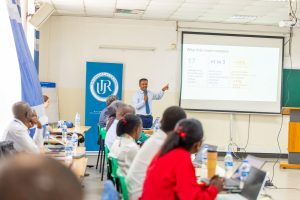
African Universities were urged to develop ways to play a pivotal role in addressing local challenges through home-grown solutions that resonate with their contexts. This was raised during the opening of the Times Higher Education-THE Africa University Summit, taking place in Kigali from 18-20 March 2025.
The THE Africa Universities Summit 2025 brings together cross-continental partners from higher education, industry, policy and civil society to discuss the greatest challenges and opportunities facing African higher education and broader society.
“I know that Rwanda has found amazing ways of homegrown solutions. The care of orphans by families, for example. That’s one of the solutions I’m talking about, where we look at our own indigenous values and use them to manage our lives and ourselves in our current situation”, Angela Owusu-Ansah, Provost, Ashesi University in Ghana, said.
“Look at what is happening in America. Aid has been withdrawn and so on. We can’t always be reliant on aid. My university for example, we don’t have a medical school. We don’t have a nursing school, we don’t have any program in health, but we are doing things in the health space through the engineers, through the computer scientists. We have got people creating apps for helping you to take your medicine on time and all those kinds of things”, she added.
Coming back to strategies to be used to reduce the number of people going abroad after completing their university studies, Angela emphasized that the universities have to find a way to make the students be proud of themselves as Africans, and have a concern for Africa, to recognize that if they don’t stay and make it change, nobody is going to do it.

According to Abiodun Adebayo, Professor and Former Vice-Chancellor, Covenant University, universities in Africa were established for the colonial system but over the years, things have changed.
“As a continent, we should have to look at our universities as places where people come to analyze the purpose of improving their society. That is one general way of shifting the focus on research. We must reprogram our curriculum to meet the needs of the time. Let’s inject program solving skills. Our mindset must be changed, that’s what we tell our students. No one will solve African problems other than African themselves”, he said.
Prof. Phil Cotton, the Vice chancellor of the University of Global Health Equity, located in the most remote and rural parts of Rwanda, pointed out that the summit serves as the opportunity to learn from different experiences to create legacy.
Joseph Nsengimana, Rwanda’s Minister of Education, stated that universities are the engine of national development and should strive to ensure that their graduates contribute effectively.
He said, “The universities are more than just institutions of higher learning; they are engines of innovation, self-reliance, and economic development. Sustainable development is not a choice; it is a necessity. Universities must integrate sustainability principles into their curricula, research, and institutional operations”, he added.
He also pointed out a significant gap between the knowledge provided by universities and the skills needed in the job market, emphasizing the urgent need to take action and build a strong education system.
Nick Davis, the Director of Times Higher Education in Africa and the Middle East, which organized the summit, stated that with 60% of Africa’s population being youth, this should be seen as an opportunity for the continent’s development. He emphasized the need for collaboration in driving progress, highlighting that quality education, technology, and innovation are the key pillars of sustainable growth.


About The Author


SUBSCRIBE TO OUR NEWSLETTER