She Builds, She Leads: Challenging Gender Norms in Rwanda’s TVET System

Despite Rwanda’s ambitious drive to promote gender equality and technical education, persistent social attitudes and outdated beliefs continue to discourage girls from fully embracing careers in traditionally male-dominated trades like electricity, plumbing, and construction. In many communities and even within Technical and Vocational Education and Training (TVET) schools, girls are still perceived as unfit for hands-on, physical work—an assumption that stifles their potential and curtails their contributions to the nation’s development.
These perceptions are not just social inconveniences; they are structural barriers. They often lead to families discouraging daughters from pursuing trades seen as “men’s work” and, consequently, limit women’s access to high-demand and well-paying technical careers. But the Salesians of Don Bosco’s TVET schools are actively confronting these stereotypes—head-on.

Father Callixte UKWITEGETSE, Principal of Don Bosco Gatenga, acknowledges the challenge, describing it as a lingering “myth” that is steadily being dismantled through education and exposure.
“There’s a myth in society that certain careers are made for girls and others for boys,” he said. “It is one of the challenges we face. But slowly, society is beginning to understand that this cleavage should no longer exist.”
Father Callixte points to the growing number of girls enrolling in male-dominated fields at the school as proof of changing attitudes. “In our girls’ boarding, enrollment rose from 61 last year to 120 this year. And in plumbing, we had only three girls last year—now we have 21 in Level One. In building and construction, the number of girls and boys is almost equal.”
He recalled his own surprise at this transformation:
“When some girls came to study construction, I said, ‘No, it’s not possible.’ But they proved me wrong. Imagine a girl saying, ‘Yes, I will climb the house.’ That’s breaking prejudice.”
He cited one former student, now a professional engineer, who often returns to encourage others:
“She always tells us, ‘Please, when you have to build, consult me—I’m now an engineer.’ That is a way of overcoming prejudice.”
The school’s efforts don’t stop at enrollment numbers. Father Callixte emphasizes the importance of reaching even more marginalized young people, especially those with disabilities or from stigmatized backgrounds.
“Some families still hide children with disabilities, not wanting others to know. But when we discover such cases, we help. Media can also play a role—when someone is left behind, we must reach out and bring them into the education system.”
He also stressed the importance of career guidance in helping students choose paths aligned with their passions, not their parents’ outdated ideas.
“There was a time when parents were experts in everything. That time is gone. Now we need trained career counselors to guide students based on their interests and abilities.”

Ms. Clémentine UZAMUREBA, Gender Officer at Don Bosco Gatenga, reiterated the school’s commitment to inclusivity.
“We are actively working to encourage more women to pursue technical education,” she said. “We firmly believe that women have a vital role to play in Rwanda’s development, and we are committed to fostering a supportive and inclusive learning environment.”

For students like Belyze AGATONI, a fourth-year plumbing student at Don Bosco Gatenga, breaking gender norms has been a liberating experience.
“We used to think this profession was only for boys. But now that we dared to get into it, we see how beneficial it is,” she said.
“TVET gives you hope—you can get a job even before finishing. I’d like to tell girls who are still afraid to study vocational education to go for it—it helps you create jobs.”
AGATONI aspires to continue her studies in water sanitation to help improve Rwanda’s access to clean water. “Now even my parents are proud of me,” she added.
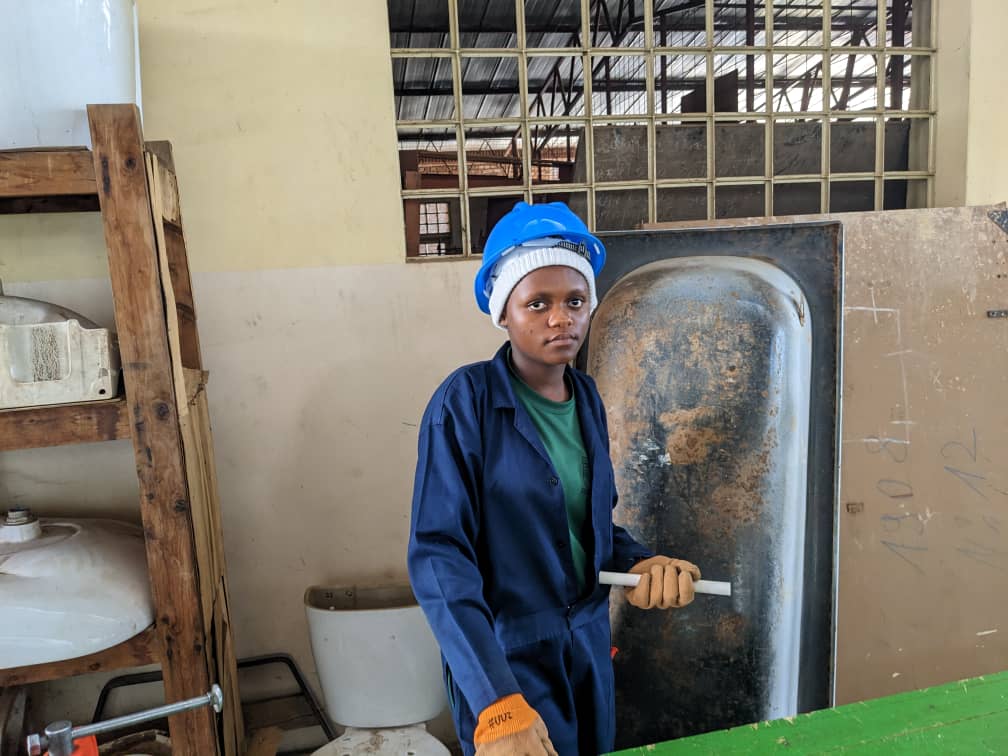
Sophia NYIRARUKUNDO, a Level Three construction student, also defied expectations.
“When I told my parents I wanted to study construction, they asked if I could really do it. I said yes—because I wanted it. This profession isn’t too hard for girls; we can do it too.”

Similarly, Jeanne MUKESHIMANA, a third-year electricity student, faced skepticism at home when she first shared her plans. She recalled how her parents initially wanted her to follow a traditional academic path.
“My parents thought I’d study Mathematics, Chemistry, and Biology (MCB). When that didn’t work, they told me to go for electricity, and now I’m happy,” she said.
“There’s profit in it—there’s money. Boys and girls can do this job. Girls are even better at some things.”
These stories reflect a broader transformation across the Salesians of Don Bosco’s TVET network in Rwanda, which includes schools in Gatenga, Rango, and Muhazi. All three are experiencing remarkable growth, especially in female enrollment.

At Don Bosco Gatenga, student numbers soared from 234 in 2022-2023 to 560 in the 2024-2025 academic year—a 139.3% increase. Female enrollment jumped by 72.6%, from 62 to 169 students.
Don Bosco Rango also saw growth, enrolling 102 students in 2024-2025, with female enrollment rising to 45 from 31 in two years. Don Bosco Muhazi recorded a 228.6% increase in female students over the same period.
These numbers aren’t just statistics—they represent changing mindsets, expanding opportunities, and a generation of young women daring to defy outdated norms.
As Rwanda continues to prioritize TVET as a cornerstone of economic development, the work of schools like Don Bosco Gatenga offers a blueprint for inclusive progress—where girls with hard hats and tool belts are just as common, and just as capable, as their male counterparts.


About The Author


SUBSCRIBE TO OUR NEWSLETTER