Burera’s comeback: Small livestock, big impact

Burera District in Rwanda’s Northern Province was once among the regions with the highest poverty rates in the past seven years, with around 49% of households affected. However, that figure has now dropped to 22%, according to the EICV7 report. The district’s leadership attributes part of this significant change to small livestock farming.
While not every household owns small livestock, authorities say many families have benefited thanks to initiatives and projects supported in partnership with various stakeholders. One of these initiatives is the PRISM project (Partnership for Resilient and Inclusive Small Livestock Markets Programme), funded by the International Fund for Agricultural Development (IFAD) and implemented by the Rwanda Agriculture and Animal Resources Development Board (RAB) through its SPIU.
Jean Baptiste Nshimiyimana, the Vice Mayor in charge of economic development in Burera District, stated that the PRISM project has been vital to the area’s development, thanks to its efforts to improve the wellbeing of local residents.
The project supported the construction of a modern market serving Gatebe and Kivuye Sectors, a pig slaughterhouse in Butaro Sector, and a veterinary pharmacy in Rusarabuye Sector.
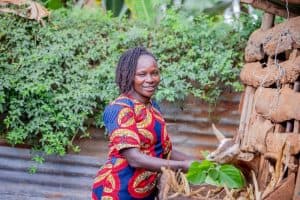
Beyond these larger, community-level developments, PRISM has distributed small livestock such as chickens, sheep, and pigs to various sectors across Burera District. At least 1,300 families received chickens, and over 480 families received goats.
These efforts have helped reduce malnutrition and stunting, and have contributed to poverty reduction, according to Vice Mayor Nshimiyimana.
“In Burera District, we launched a determined fight against poverty, bringing the rate down from 49% to 22%. That’s a significant impact, and PRISM played a role by improving the livelihoods of our citizens”, he explained.
“We also faced a problem of egg shortages, especially in Early Childhood Development (ECD) centres across the district. Now, children have access to eggs, and even those who don’t own chickens can buy them locally. We expect to see improvements in nutrition indicators soon. Furthermore, we encouraged residents to join self-help groups. They now save money from selling eggs and can access small loans, which gives us confidence that this programme will remain sustainable even after the project ends.”

Residents have been passing on livestock through a repayment scheme similar to the Girinka programme, meaning more people are gaining access to small livestock, and the benefits are expected to continue even after the project concludes, Nshimiyimana added.
Paul Semwogere, a resident of Nyagahinga Cell in Cyanika Sector, said that before the PRISM project began, some children in his village were affected by malnutrition. This has now improved, as parents have learned how to prepare balanced meals that include eggs from the chickens they received.
Ephrem Nzabahambya also said that PRISM had greatly benefited him. Starting with 10 chickens, they have multiplied, and he now collects around 80 eggs a week.
He said, “I used to struggle to get money for basic household needs, but now I earn from selling eggs. I didn’t even have chairs in my home, but I’ve been able to buy some. I also took a loan from my savings group and I’m now renovating my house. We never used to eat eggs, but now we have them every day.”
Another way the project has helped is by establishing self-help groups, which have reduced household and community conflicts caused by informal and exploitative lending practices.
Each week, members of PRISM savings groups contribute 1,000 Rwandan Francs, amounting to 4,000 per month. At the end of each month, these funds are loaned out to members in need, helping them solve various challenges.
The PRISM Project has a total duration of 5 years, having become effective in March 2021, and is scheduled to close in September 2026. The overall objective of the project is to reduce poverty by empowering poor rural men, women and youth to participate in the transformation of the Rwanda livestock sector and to enhance their resilience. Specifically, the programme seeks to increase competitiveness and profitability of the small livestock sector for the provision of quality products from smallholder producers to domestic and regional consumers.
The Project is intervening in 15 Districts, distributed across the Northern (Gakenke, Musanze, Burera, Rulindo and Gicumbi), Southern (Ruhango, Huye, Gisagara, Nyaruguru and Nyamagabe) and Western (Nyabihu, Rutsiro, Ngororero, Karongi and Nyamasheke) provinces. The selection of districts was done based on the level of incidence of poverty and food insecurity as well as the comparative advantage for the development of the targeted small livestock value chains.


About The Author


SUBSCRIBE TO OUR NEWSLETTER