How Terracing Is Helping Ndego, Kayonza Cope with Drought

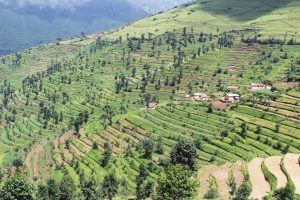
In Rwanda’s Eastern Province, where drought once pushed many families to the brink of hunger and displacement, green terraces now stretch across the hills of Ndego Sector in Kayonza District, signaling a quiet agricultural transformation.
For years, farmers in this drought-prone area struggled with low harvests, soil erosion and repeated food shortages. Today, with land husbandry activities carried out under the Kayonza Irrigation and Integrated Watershed Management Project – Phase II (KIIWP2), communities say they are slowly regaining control over their land and improving their livelihoods.
From Washed-Away Fields to Stable Harvests
On more than 100 hectares in Kiyovu Cell, Mwurire Village, terraces have been developed under KIIWP2 support. The intervention includes radical terracing, planting elephant grass along contour lines, distribution of improved seeds and farmer training.

Vincent Ndahimana, president of the 35-member Duhuze Imbaraga farmers’ group, recalls how difficult farming used to be.
“Before the terraces were constructed, this land was in very bad condition. There was serious soil erosion, and the harvests were very low,” he says. “A farmer could cultivate one hectare and harvest less than 50 kilograms of maize.”
Heavy rains would wash soil downhill, carrying away both seeds and nutrients. During dry spells, crops would wither in depleted fields.
“Now, things have changed,” Ndahimana explains. “The terraces stop the water from running off with our soil. We planted beans and maize this season using seeds provided by the project, and the crops are growing well.”

Today, farmers who once harvested less than 50 kilograms of maize per hectare report yields of up to two tonnes. With continued training and improved farming practices, they believe production could increase even further.
For Ndahimana, the impact is not only visible in the fields but also at home.
“I have been able to buy a bicycle. My children go to school, and I can pay for their community health insurance,” he says. “This is the third year since the terraces were built, and we now farm with confidence.”
Ending a Cycle of Hunger and Displacement

Christine Mukagasana, a member of the Duhuze Imbaraga group, has lived in the area for 23 years. She remembers seasons marked by hunger and uncertainty.
“We suffered a lot. Sometimes we had to leave because of hunger and then come back,” she says. “We even consumed seeds meant for planting because of food shortages.”
Before the terraces were established, fertile soil would be swept away whenever it rained heavily.
“Previously, you would see the soil disappear,” Mukagasana explains. “Now we are able to protect it. Since these terraces were introduced, life has slowly improved. We received seeds and fertilizers. We are no longer facing extreme hunger, and we will not have to leave again.”
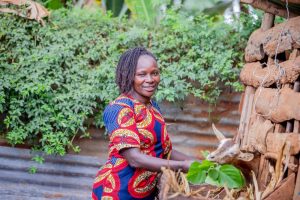
The elephant grass planted along the terraces has also become a lifeline for livestock farmers.
“Our animals now have enough to eat,” she says. “I have goats and I bought a pig. The grass helps me feed them without struggling.”

Liverie Manirakiza, another group member, says the terraces have reduced the fear that once came with every heavy rainfall.
“Before, erosion would destroy our crops,” she says. “Rainwater coming from the hills would wash everything away. Now, even if it rains heavily, we trust that the terraces will protect our fields.”
She adds that access to elephant grass has reduced open grazing and land degradation. “We no longer have to search far for pasture. The fodder is right here.”
A Response to Recurrent Drought
In 2016, Eastern Province was severely affected by drought, leaving more than 47,000 people food insecure, forcing the government to provide emergency food and water assistance.
To reduce vulnerability to such climate shocks, the Government of Rwanda, in partnership with the International Fund for Agricultural Development (IFAD), initiated the Kayonza Irrigation and Integrated Watershed Management Project (KIIWP).
The project was designed in two phases. Phase I (2019–2024) focused on immediate drought response and preparatory studies. Phase II (2022–2028) is scaling up investments to strengthen food security, increase household incomes and build long-term climate resilience.

Jean de Dieu Rudacogora, a KIIWP2 Access to Finance Specialist, says land husbandry activities are central to supporting farmers in rain-fed areas.
“We supported communities in Ndego to construct terraces, plant elephant grass and access improved seeds,” he explains. “We also provide training to help them improve soil productivity and increase yields.”
The project aims to cover 1,950 hectares under land husbandry in rain-fed areas. So far, 1,246 hectares have been completed.
KIIWP2 operates in nine drought-prone sectors of Kayonza District: Gahini, Kabare, Kabarondo, Murama, Murundi, Mwiri, Ndego, Ruramira and Rwinkwavu. It seeks to improve food security and incomes for at least 40,000 rural households on a sustainable basis while strengthening resilience to climate change.
To date, the project has reached 31,359 individuals, prioritizing vulnerable communities. Women account for 54 percent of beneficiaries, while youth represent 30.6 percent. Overall, the initiative is expected to reach 180,000 people, with strong inclusion of women and young people.


About The Author


SUBSCRIBE TO OUR NEWSLETTER