Farmers in Kayonza District Celebrate Improved Access to Loans from Financial Institutions

For many years in Rwanda, agriculture has been the backbone of rural livelihoods, providing food and income to millions of households. Despite its importance, however, farmers have long faced serious challenges in accessing financial services, particularly loans from banks and microfinance institutions.
In the past, most financial institutions considered agriculture a high-risk sector. Many believed that farmers could not reliably repay loans because of unpredictable weather conditions, crop diseases, and fluctuating market prices. As a result, farmers who applied for loans were often denied or required to provide collateral that many of them did not possess.
Because of these challenges, many farmers continued practicing subsistence farming with limited resources. Without access to credit, they struggled to purchase improved seeds, fertilizers, irrigation equipment, and other modern farming inputs that could increase productivity.
Today, however, the situation is gradually changing. In Rwinkwavu Sector of Kayonza District in Eastern Rwanda, several farmers say they are now able to access loans from financial institutions something that was nearly impossible in the past. These loans are helping them expand their farming activities and improve their livelihoods.
Mutuyeyesu Marie , a farmer from Rwinkwavu Sector, says the change has been significant.
“In the past, when we tried to apply for loans, financial institutions told us that farming was too risky. They asked for collateral that most of us did not have. Because of that, many farmers remained stuck in small-scale farming,” she explains.
According to Mutuyeyesu, the situation began to change when financial institutions started recognizing the potential of agriculture as a productive investment.
After receiving a loan, she was able to purchase fertilizers and improved seeds, which significantly increased her harvest.
Another farmer, Ndayisenga Vales, says access to credit has helped him improve his farming practices.
“The loan helped me buy quality seeds and fertilizers. My production increased compared to previous seasons, and I was able to repay the loan while still making a profit. Now I am planning to expand my farming activities,” he says.
Farmers in the area say that beyond providing capital, these loans have also given them confidence to view agriculture as a profitable and sustainable profession.
On the side of financial institutions, officials say the change in attitude toward lending to farmers has been largely influenced by training and partnerships with government-supported agricultural projects.
Uwamahoro Theodose, the Loans Officer at Twifatanye SACCO Rwinkwavu, explains that their institution began offering more agriculture-related loans after receiving training from a government initiative focused on irrigation and watershed management in Kayonza District.
“The training helped us understand that agriculture can be a reliable sector if farmers receive proper support and guidance. We realized that farmers are capable of repaying loans when they have access to the right resources and knowledge,” Uwamahoro says.
She adds that farmers are now better prepared when applying for loans, as many of them present clear farming plans showing how the funds will be used and how the loans will be repaid.
Currently, Twifatanye SACCO Rwinkwavu has more than 16,000 members and has issued loans worth over 650 million Rwandan francs that are still active among borrowers. A portion of these loans has been granted to farmers engaged in different agricultural activities.
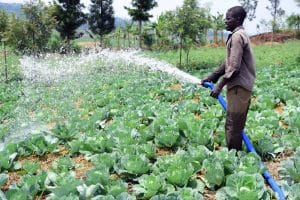
Through these loans, farmers have been able to increase the size of their cultivated land, purchase improved farming inputs, and adopt better farming techniques, including irrigation during dry seasons.
In addition, the government initiative known as the Kayonza Irrigation and Integrated Watershed Management Project (KIIWP) is playing an important role in supporting farmers in the district. The project focuses on improving irrigation systems and strengthening agricultural productivity.
One of the key components of the project is facilitating farmers’ access to credit by supporting loan programs. Under this initiative, farmers working with the project can receive financial support in which up to 70 percent of the loan amount is subsidized, making it easier for them to invest in modern agriculture.
Farmers in Rwinkwavu believe that this support will help transform agriculture in the region by enabling more farmers to invest in improved farming practices.
Mutuyeyesu Marie says the changes have already begun to improve the lives of many rural families.
“When farmers gain access to capital and knowledge, agriculture becomes more productive. We hope more farmers will benefit from these opportunities so that our livelihoods can continue to improve,” she says.
The progress seen in Kayonza District demonstrates how collaboration between farmers, financial institutions, and government programs can transform agriculture into a reliable and profitable sector. With continued support, access to credit is expected to play a crucial role in strengthening rural development and improving the economic well-being of farming communities across the region.
About The Author


SUBSCRIBE TO OUR NEWSLETTER