New Data Reveals Shifting American Values on Marriage and Global Housing Concerns
A new report from Gallup highlights significant shifts in public opinion, ranging from renewed American perspectives on marriage to growing global struggles with housing affordability and progress in the fight against world hunger.
A Rebound in Attitudes Toward Marriage
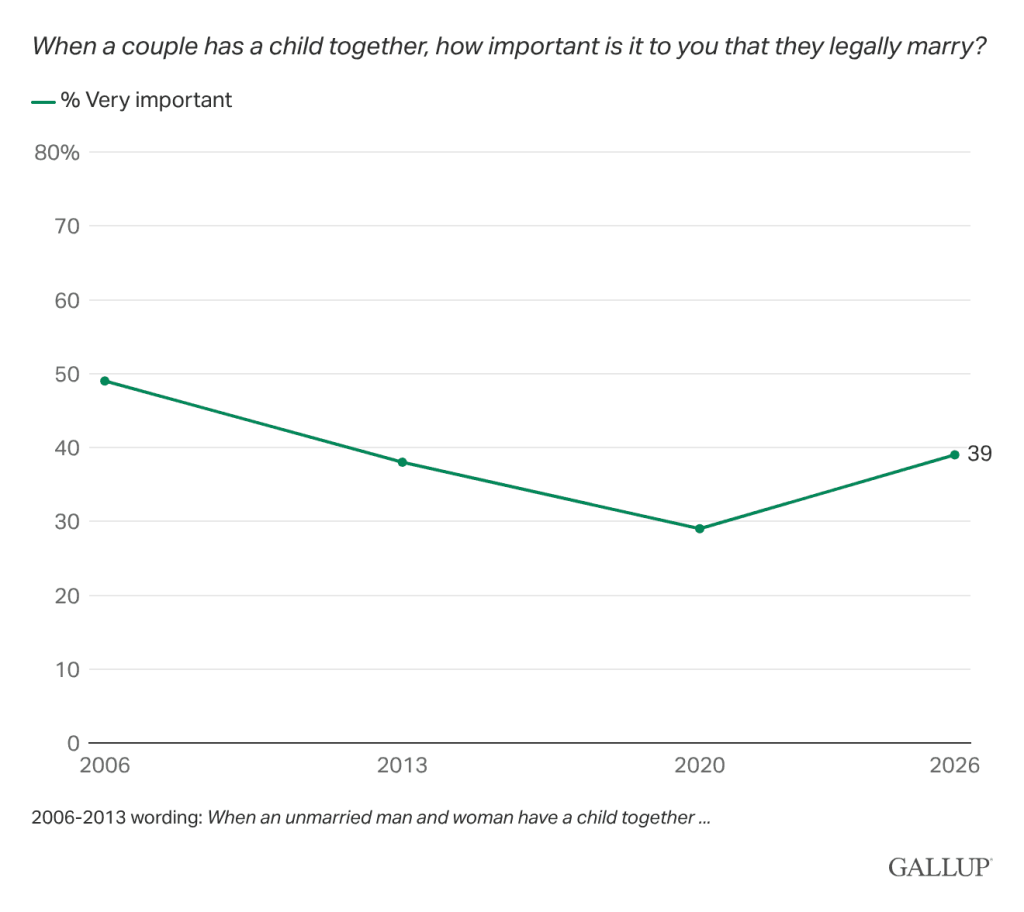
Data from 2026 shows a partial rebound in the number of Americans who believe it is very important for couples who have a child together to legally marry. This sentiment has risen to 39%, a notable increase from the 29% recorded in 2020.
This shift marks a deviation from the trend observed between 2006 and 2020, during which the importance placed on marriage for such couples dropped by 20 percentage points. Americans now view marriage as roughly equally important for couples with children (39%) as it is for couples planning to spend their lives together (37%), a shift from previous years when committed partnerships were consistently viewed as higher priority for marriage than those sharing children.
Partisan Divides in Marriage Views
The rise in the perceived importance of marriage is not uniform across the political spectrum. Fifty-eight percent of Republicans now say it is very important for parents of a child to legally marry—a 22-point increase since 2020. In contrast, support stands at 39% among independents and 21% among Democrats, with the latter remaining near record lows for that group.
Global Housing Affordability Challenges
Beyond social trends, the report highlights a worldwide struggle with housing. Over the past 20 years, the median percentage of adults globally who report difficulty affording adequate shelter has risen by 10 points, reaching 28%. Despite this struggle, satisfaction with housing availability has remained relatively stable near 50%.
This discrepancy is particularly sharp in high-income nations. In countries like Canada, New Zealand, the United States, Ireland, and Australia, the gap between personal affordability and overall satisfaction with housing markets has widened significantly, with the dissatisfaction gap now exceeding 50 points in most of these nations.
Progress Against World Hunger
On a more positive note, the global prevalence of undernourishment fell to 7.8% in 2025, marking the third consecutive year of decline since the peak of the COVID-19 pandemic. This improvement equates to approximately 645 million people experiencing hunger, a reduction of 43 million compared to 2022 figures.
Notably, Africa recorded its first improvement since 2015, with undernourishment declining to 20.0% in 2025. These figures place global hunger levels slightly below where they were in 2015 when the United Nations’ Sustainable Development Goals—which target the elimination of hunger by 2030—were first adopted.
About The Author


SUBSCRIBE TO OUR NEWSLETTER