At Rwanda AgriShow, ACES Demonstrates How Sustainable Cooling Can Accelerate Agrifood Systems Transformation
Odile Mukeshimana
KIGALI, Rwanda-Sustainable cooling was among the practical solutions highlighted at this year’s Rwanda AgriShow as stakeholders explored innovations supporting the event’s theme, “Accelerating Agri-Food Systems Transformation through Innovation and Strategic Partnerships.”
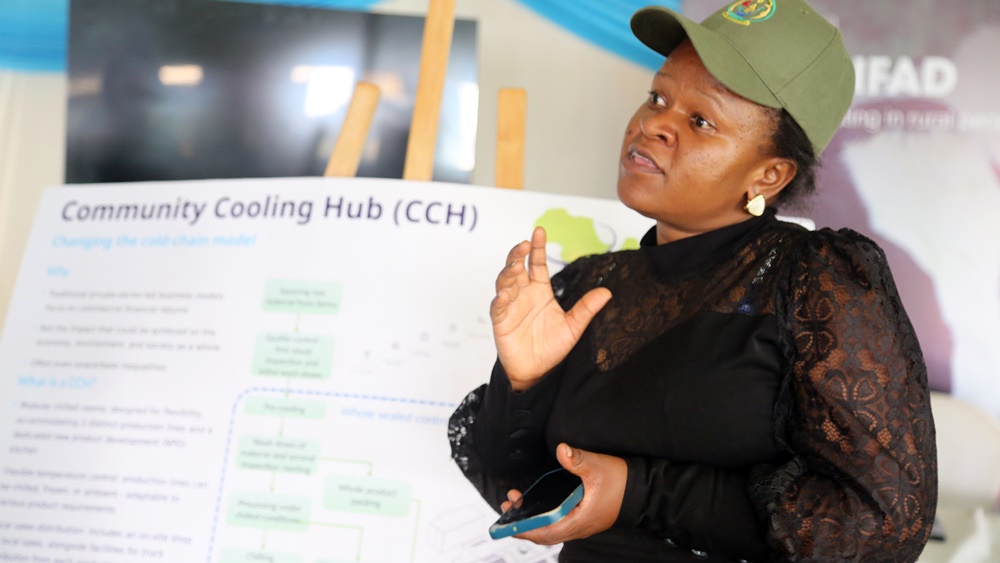
Among the exhibitors, the Africa Centre of Excellence for Sustainable Cooling and Cold-chain (ACES) presented its Community Cooling Hub (CCH) model, demonstrating how sustainable cooling can strengthen food security, climate resilience, and inclusive rural development.
Speaking to TOP AFRICA NEWS at the ACES stand, Odile Mukeshimana, representing ACES during the exhibition, explained that the Community Cooling Hub is far more than a cold room. It is an integrated, community-centred model that brings together pre-cooling, cold-chain services, clean energy, value addition, food safety, market access, capacity development, and essential community services to respond to local needs.
“The Community Cooling Hub is much more than a cold room. It is an integrated model designed around community needs. By bringing together sustainable cooling, value addition, clean energy, market access, food safety, and capacity development, it helps communities reduce food loss, strengthen livelihoods, and build more resilient agrifood systems,” Mukeshimana said.
She explained that the Community Cooling Hub begins with pre-cooling, which removes field heat immediately after harvest before produce enters cold storage. This helps preserve quality, maintain food safety, extend shelf life, and reduce post-harvest losses before products move through storage, value addition, processing, and markets.

“Cooling helps farmers preserve the quality of their harvest, improve food safety, reduce post-harvest losses, and create greater value from what they produce,” she added.
Creating Value Through Integrated Services
Beyond cold storage, the Community Cooling Hub supports value addition by providing opportunities to process agricultural products, helping farmers increase the value of their produce while opening new market opportunities.
Mukeshimana cited tomato processing as one example, explaining that transforming fresh tomatoes into tomato paste creates additional income while reducing waste.
“Value addition allows farmers and processors to capture greater value than selling fresh produce alone while reducing post-harvest losses,” she said.
Depending on local priorities, the Community Cooling Hub can also support vaccine cold chains and other essential community services, showing how sustainable cooling contributes to both agriculture and public health.
Research-Based Innovation
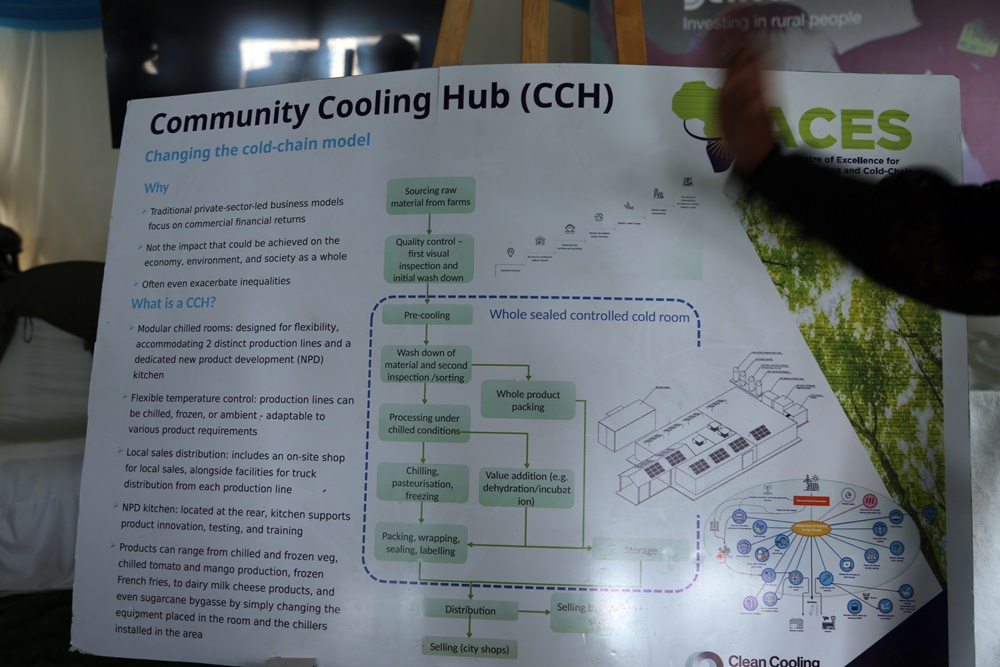
Mukeshimana said the Community Cooling Hub is the result of scientific research conducted by ACES.
Rather than introducing the same solution everywhere, ACES begins each intervention with a comprehensive needs assessment to understand local production systems, market opportunities, energy availability, and community priorities before designing a model that responds to those needs.
“Every Community Cooling Hub begins with understanding the needs of the community. It is evidence-based and designed to respond to local realities. Rather than applying a one-size-fits-all solution, we develop an integrated model that addresses the specific challenges and opportunities within each community,” she explained.
She added that the model can be adapted and replicated according to local production systems and development priorities.
The Community Cooling Hub reflects ACES’ systems-thinking approach to sustainable development. Rather than viewing cooling as a standalone technology, the model connects agricultural production, pre-cooling, cold-chain services, value addition, clean energy, food safety, market access, public health, and community capacity development into one integrated system.
By strengthening the links between these components, it helps communities build more resilient agrifood systems while creating social, economic, and environmental benefits.
Embedding Gender Equality and Social Inclusion
Mukeshimana said Gender Equality and Social Inclusion (GESI) is embedded throughout the Community Cooling Hub model.
Rather than treating inclusion as a separate activity, ACES integrates GESI from the initial needs assessment through governance, access to services, training delivery, leadership opportunities, and business development to ensure that women, young people, persons with disabilities, and other underrepresented groups can participate meaningfully and benefit equitably.
“Sustainable development can only be achieved when everyone has an opportunity to participate and benefit. That is why Gender Equality and Social Inclusion is integrated throughout the Community Cooling Hub model, from planning and implementation to training and community engagement,” she said.
Capacity development is another important part of the ACES approach. Alongside the Community Cooling Hub, ACES offers professional short courses and online learning opportunities that prepare technicians, researchers, policymakers, entrepreneurs, and community leaders to design, operate, and scale sustainable cooling solutions. Current training areas include sustainable cooling and cold-chain systems, refrigeration, food safety, clean energy, telemetry, and Gender Equality and Social Inclusion (GESI), helping build the skilled workforce needed to support Rwanda’s cooling transition.
Raising Awareness at Rwanda AgriShow
Throughout the exhibition, the Community Cooling Hub attracted interest from farmers, students, researchers, policymakers, development partners, and private-sector stakeholders looking for practical solutions to strengthen agricultural value chains.
Mukeshimana said the AgriShow provided an opportunity not only to demonstrate the Community Cooling Hub model but also to engage visitors in discussions on how sustainable cooling can support agrifood systems transformation through research, innovation, partnerships, and capacity development.
“The AgriShow allows us to demonstrate how sustainable cooling can support communities beyond reducing post-harvest losses. It is also an opportunity to introduce visitors to our professional short courses and online learning opportunities, helping build the knowledge and skills needed to support the cooling transition,” she said.
Rather than being simply a cooling facility, the model offers a practical, research-driven approach to using sustainable cooling as an enabler of agrifood systems transformation.
About The Author


SUBSCRIBE TO OUR NEWSLETTER