How Environment-Linked Sectors Contributed to Rwanda’s Economy in 2025
By Ange de la Victoire DUSABEMUNGU
KIGALI — Rwanda’s economy reached RWF 23,387 billion in 2025, expanding by 9.4%, with agriculture contributing 20% of gross domestic product (GDP), according to the National Institute of Statistics of Rwanda (NISR). The figures underline the importance of land-based production and natural resources to the country’s economy, while also highlighting the need to measure the wider economic value of forests, wetlands, water and biodiversity.
The 2025 national accounts show that agriculture grew by 7%, industry by 11% and services by 9%. Although not all industrial activity is environmentally dependent, mining, quarrying, energy, water and other resource-linked activities form part of the relationship between the economy and the natural environment.
Agriculture accounted for one-fifth of GDP
Agriculture contributed 20% of Rwanda’s GDP in 2025, making it a major pillar of the economy. The sector grew by 7%, supported by increases in both food and export crop production.
Rwanda’s GDP structure in 2025
Share of GDP by broad sector
Source: NISR, GDP National Accounts 2025. Data year: 2025. Release/update: 28 April 2026. Percentages are rounded by NISR.
Within agriculture, export crop production increased by 32%. Coffee production rose by 60%, while tea production increased by 8%. Food crop production grew by 3%.
Growth in selected agricultural activities
Annual growth rate, 2025
Source: NISR, GDP National Accounts 2025. Data year: 2025. Release/update: 28 April 2026.
The performance of coffee and tea demonstrates how agricultural exports depend on natural conditions. Soil quality, rainfall, water availability and changing temperatures influence yields and the livelihoods of farming households. Protecting these resources is therefore directly connected to agricultural productivity and export competitiveness.
Mining and industry add to the natural-resource economy
Industry accounted for 22% of GDP and grew by 11% in 2025. Within the sector, mining and quarrying increased by 17%, construction by 11% and manufacturing by 10%, according to NISR.
Mining contributes to exports, industrial activity and public revenue. At the same time, mineral extraction requires effective environmental impact assessments, pollution controls, responsible water use and rehabilitation of mined land. The economic gains from extraction should be considered alongside the costs and risks of environmental damage.
Climate-related interventions receive a significant budget share
The Government has also incorporated climate considerations into public financial planning. The Ministry of Finance and Economic Planning’s Citizen Budget Guide for FY2025/2026 estimates that climate-change-related interventions represent 7.5% of the total Government budget.
The guide divides climate-related spending into adaptation, mitigation, and interventions that contribute to both objectives.
Composition of climate-related budget allocations
FY2025/2026
Source: MINECOFIN, Citizen Budget Guide FY2025/2026. Guide publication year: 2025. Financial year covered: 2025/2026. Overall climate-related interventions: estimated at 7.5% of the national budget.
Adaptation measures are intended to reduce vulnerability to climate impacts, including through climate-resilient agriculture, water management and disaster-risk reduction. Mitigation interventions aim to reduce greenhouse gas emissions, including through cleaner energy and other low-carbon investments.
The 7.5% figure represents a budget estimate for climate-related interventions. It is not a measure of the environment’s contribution to GDP, nor does it indicate how much of the allocation was ultimately spent.
The economic value of nature is not fully captured
Although the national accounts record production in agriculture, forestry-related activities, mining, manufacturing and other sectors, conventional GDP does not fully measure the benefits that ecosystems provide to the economy.
Wetlands help regulate floods; forests store carbon, protect watersheds and reduce soil erosion; and healthy soils support food production. These services have economic value even when they do not generate a direct market transaction.
The 2025 GDP release does not provide a consolidated monetary estimate of the value of Rwanda’s natural capital or the contribution of ecosystem services. Nor should the 20% agricultural GDP share be described as the total contribution of the environment: agriculture is only one sector, and it is not equivalent to the whole environmental economy.
A case for stronger natural capital accounting
Rwanda’s 2025 economic figures show that the country’s growth is closely linked to natural resources. Agriculture accounted for one-fifth of GDP, export crops recorded strong growth, and mining and quarrying expanded by 17%. Meanwhile, the Government allocated a significant share of its FY2025/2026 budget to climate-related interventions.
A more complete picture would require natural capital accounting that connects economic statistics with information on the condition and value of forests, wetlands, water resources, soils and biodiversity. It would also help quantify the economic costs of pollution, land degradation and ecosystem loss.
For policymakers, investors and communities, such information could improve decisions about infrastructure, agriculture, mining, conservation and climate investment. It would help establish not only how quickly the economy is growing, but also whether that growth is preserving the natural assets on which future prosperity depends.
Rwanda’s environment is not separate from its economy. It is part of the foundation supporting agricultural production, exports, industrial activity and long-term resilience.
Sources and data notes
- National Institute of Statistics of Rwanda (NISR), GDP National Accounts 2025 — reference year 2025; last updated 28 April 2026.
- Ministry of Finance and Economic Planning (MINECOFIN), Rwanda’s Economy Registers 9.4% Growth in 2025 — published in 2026; reports 2025 economic performance.
- MINECOFIN, Citizen Budget Guide FY2025/2026 — guide published in 2025; covers the 2025/2026 financial year.
Data clarification: Calendar-year 2025 GDP figures and FY2025/2026 budget estimates refer to different reporting periods. The percentages shown in the graphics are reproduced from the cited official publications. The climate-budget distribution totals 100% as presented in the Citizen Budget Guide; the overall 7.5% is the Government’s estimate of climate-related interventions as a share of the national budget.
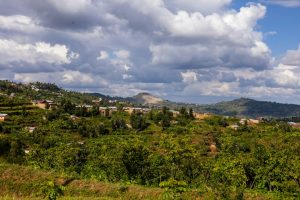
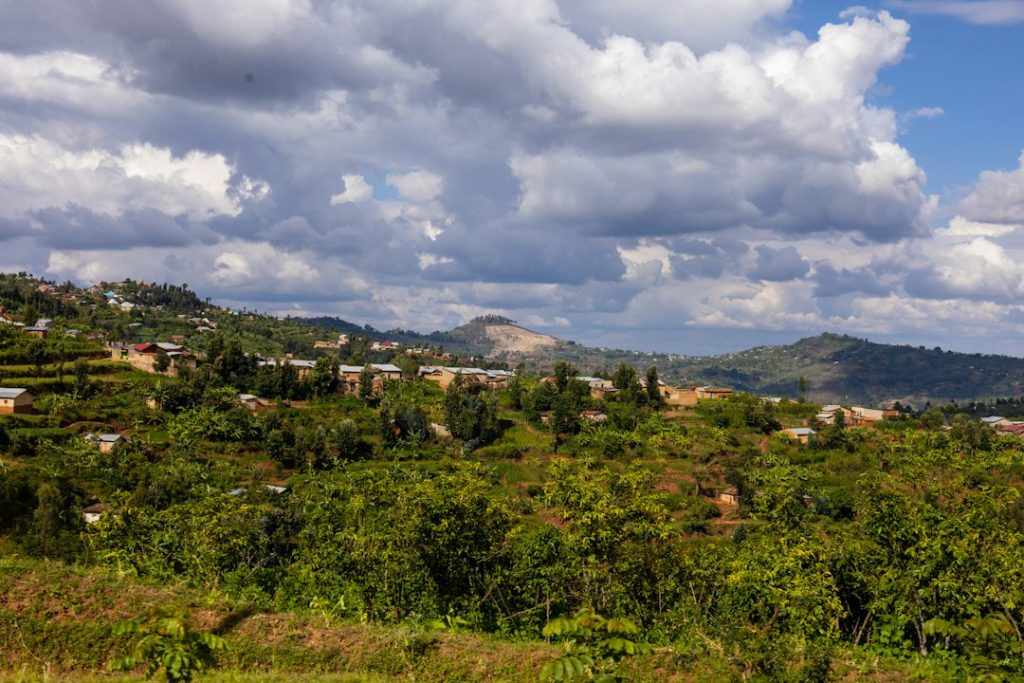
Featured image: Green hillside landscape. Photo by Tobias Doering via Unsplash (illustrative image; not a statistical representation of the data).
About The Author


SUBSCRIBE TO OUR NEWSLETTER