Rwanda’s Climate-Resilient Harvest Starts After the Crops Leave the Field

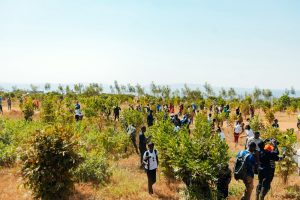
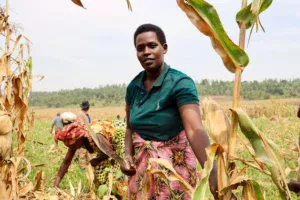
Alice, a Congolese refugee, harvesting maize in Nyabicwamba marshland.
KIGALI, Rwanda — A farmer can produce a healthy harvest and still lose income if rain interrupts drying, grain is stored while damp or perishable produce cannot reach buyers in time. As Rwanda adapts agriculture to a changing climate, protecting crops after harvest deserves as much attention as increasing production in the field.
Weather affects the entire farming cycle. Unseasonal rain during harvest can delay drying and raise the risk of spoilage, while poor storage and handling can reduce quality before produce reaches a market. These losses matter for household earnings, food availability and the cost of supplying consumers.
Rwanda’s Ministry of Agriculture has previously highlighted how less predictable rainfall can disrupt traditional grain-drying practices, which depend on periods of dry weather. The ministry has pointed to drying facilities, warehouses, silos, equipment and training as part of the response.
Climate adaptation is not only about irrigation
National agricultural data show that adoption of some climate-resilience practices is growing, but important gaps remain. In Season B of 2026, 13.1% of surveyed farmers reported using irrigation, while 58% practised agroforestry, according to the National Institute of Statistics of Rwanda’s Seasonal Agricultural Survey.
These figures describe reported practices among surveyed farmers; they do not, by themselves, measure the quality of irrigation access or how much a particular practice reduces losses. They do underline why adaptation requires several tools rather than a single solution.
Irrigation can help farmers manage dry spells where water is available and systems are affordable. Agroforestry and soil-conservation measures can support healthier land and reduce erosion. But neither practice solves the problem of wet grain, inadequate storage or a lack of timely information about changing weather.
Better forecasts need to reach farmers in usable form
Climate information is most valuable when it helps people make a decision. A forecast of likely rainfall can inform when to harvest, dry crops, move produce under cover or arrange transport. Farmers need information that is timely, locally relevant and communicated in languages and formats they can use.
The International Fund for Agricultural Development has documented Rwanda’s Climate-Resilient Post-Harvest and Agribusiness Support Project, which used a Participatory Integrated Climate Services for Agriculture approach. The model combined weather information with farmers’ own knowledge to improve decisions. IFAD’s project summary reports improvements in post-harvest outcomes, yields and household food security among participating households.
Such approaches work best when climate advice is connected to practical options. A farmer warned of rain still needs access to a drying shelter, suitable storage, labour or transport. Information alone cannot protect a harvest when the necessary equipment and facilities are out of reach.
What would make the biggest difference?
First, districts and agricultural cooperatives can identify where harvest-time rain, limited drying space or storage problems create the greatest losses, then prioritise shared facilities close to producers. Facilities need maintenance plans and transparent access rules so that small-scale farmers can use them when they need them.
Second, extension services and weather agencies can strengthen links between seasonal forecasts, short-term alerts and crop calendars. Advice should explain what farmers can do—not simply announce that rain is expected—and should acknowledge uncertainty.
Third, farmer organisations, buyers and processors can coordinate harvesting, collection and storage so that produce is not left waiting in exposed conditions. Affordable moisture testing, improved packaging and better handling can also help preserve quality, depending on the crop.
Finally, support should reflect differences among crops and districts. Grain drying, vegetable cooling and safe storage for roots and tubers require different equipment and approaches. Local planning should be based on evidence about the main losses farmers actually experience.
Measure what farmers keep, not only what they grow
Climate-smart agriculture is often judged by yields, hectares irrigated or trees planted. Those measures matter, but they tell only part of the story. Tracking the share of harvest that reaches the market in good condition, the price farmers receive, and the losses avoided after extreme weather would give a fuller picture of resilience.
For Rwanda, a climate-resilient food system will depend not only on producing more, but also on protecting what has already been produced. Better drying, storage, climate information and market coordination can help ensure that a difficult season does not erase months of farmers’ work.
Sources: National Institute of Statistics of Rwanda, Seasonal Agricultural Survey — Season B, 2026; International Fund for Agricultural Development, Rwanda Climate-Resilient Post-Harvest and Agribusiness Support Project; Rwanda Ministry of Agriculture and Animal Resources, climate change and post-harvest management.
About The Author


SUBSCRIBE TO OUR NEWSLETTER