TREPA project empowers Eastern Rwanda’s beekeepers with modern tools and training

The Transforming Eastern Province through Adaptation (TREPA) project in the Eastern Province of Rwanda, through the International Centre for Research in Agroforestry (CIFOR-ICRAF), has equipped local beekeepers with equipment to help them foster biodiversity conservation, promote financial resources, and enhance resilience.
The equipment distributed among organised cooperatives includes modern beehives, beekeepers’ clothing, automatic hand dryers, and fire extinguishers. This follows an assessment that showed that beekeepers in the Eastern Province still face some challenges related to equipment within the honey value chain and a lack of knowledge, leading them to continue practising traditional beekeeping methods. As a result, the yield remains low and fails to meet quality standards, according to Egide Gwaneza, the socio-economist at CIFOR-ICRAF.
In 2021, the Government of Rwanda and the International Union for Conservation of Nature (IUCN) secured a funding of USD33.8 million from the Green Climate Fund (GCF) and $15.8 million as co-finance from Implementing Partners to implement the project entitled “Transforming Eastern Province through Adaptation,’’ commonly known as the TREPA project.
IUCN, through the Project Management Unit (PMU), jointly executes the implementation of the six-year investment in collaboration with the Government of Rwanda through Rwanda Forestry Authority (RFA), Enabel, CIFOR-ICRAF, Cordaid, and World Vision.

Josephine Bagiraneza, President of the Akagera Beekeeping Union, said: “ICRAF discovered that, in truth, we had no formal knowledge of beekeeping; they began by offering us training on how to care for bees and taught us how to practise modern beekeeping, as we previously used traditional beehives. We lacked many tools, but we are grateful to the TREPA project for providing equipment to help us meet quality standards.”
Clementine Nyirambarubukeye, a beekeeper from Rwamagana District, said: “We have received modern beehives, which will help us harvest and process honey that meets quality standards. We would harvest at night using smoke in the past, and often the bees would bite us. Now, we’ve seen the difference.”
Ernest Ndikubwimana, a beekeeper in Gishari, also stated that the equipment they received will allow them to engage in beekeeping not just to produce honey for home consumption or for making local brews, as was done in the past, but to access markets and earn an income that can improve their livelihoods.
Jane Mutune, Co-lead value chain development at CIFOR-ICRAF, said beekeeping is essential for improving income and livelihoods and providing a healthy ecosystem.
“When you see a bee, you can be sure that the ecosystem is healthy, but when you don’t see a bee, it is a sign of a polluted and degraded environment”, she said.
Dietmar Stoian, lead value chain development at CIFOR-ICRAF, said: “We want to ensure these cooperatives are equipped with tools and equipment to meet food safety standards.”
The Executive Secretary of Gatsibo Sector, Geoffrey Mutabazi, urged the beekeepers who received equipment to take good care of it and afford their own tools without relying on aid in the coming years.
Thanks to effective practices that result in sufficient honey production, as there is already a market for it, his counterpart from Gishari Sector, Emmanuel Ntwari, praised the cooperatives involving young people in beekeeping, noting that they will help ensure continuity of the activity when older members can no longer work as actively.
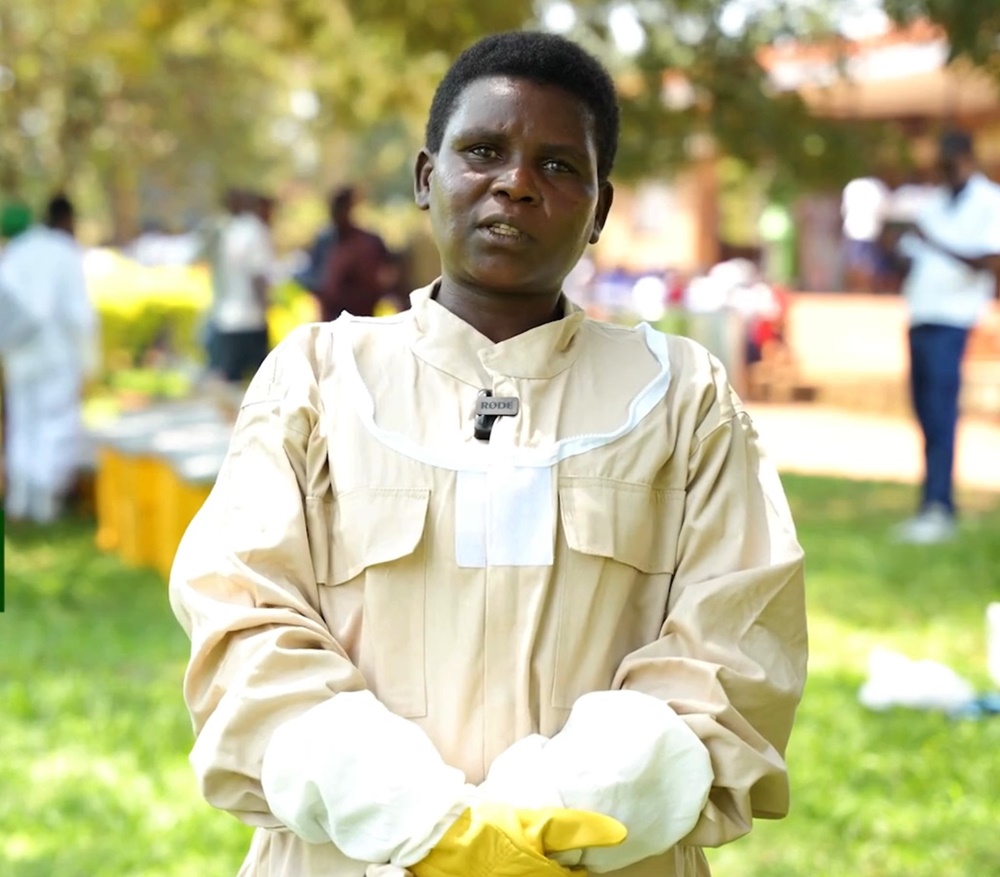
In addition to receiving equipment, beekeepers are also trained to plant nectar-producing trees for bees and make candles, soap, cosmetic oils, beeswax products, and other items that can help them generate income.
Beekeeping and insect farming have the potential to provide income for rural households, particularly for small-holder women farmers.
Rwanda’s annual honey production reached 7,000 tonnes as of August 2024, indicating progress, but it still fell short of the 8,611-tonne target set earlier under the fourth Strategic Plan for Agriculture Transformation (PSTA4). Under PSTA4, the country targeted increasing honey production from 5,535 tonnes in 2017 to 8,611 by June 30, 2024.
According to the Rwanda Agriculture and Development Board (RAB), achieving the target was challenging due to habitat loss caused by urbanisation and monoculture, which limit diverse foraging areas for bees.
The TREPA project would play a remarkable role in restoring bee habitats. Under PSTA5, the goal is to increase honey production to 10,000 tonnes by addressing the challenges that have hindered progress.
The TREPA project aims to shift the eastern province from degraded to resilient landscapes and from fragile to sustainable livelihoods. The project has already started showing success stories, targeting to restore 60,00 ha of degraded land for increased resilience across all seven districts, namely Bugesera, Gatsibo, Kayonza, Kirehe, Ngoma, Nyagatare, and Rwamagana.


About The Author


SUBSCRIBE TO OUR NEWSLETTER