Empowering Agriculture and Environmental Protection: The Innovative Journey of Chantal Kamashazi in Rwanda’s Circular Economy

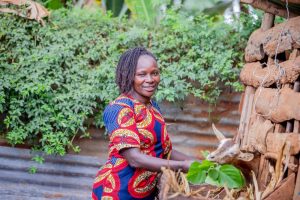
Rwandan Chantal Kamashazi is one of the most promising young innovators in agriculture and environmental preservation. She founded Mind Valley Rwanda Ltd, a company dedicated to turning waste into fertilizer—aiming to help farmers increase their yields sustainably.
Mind Valley Rwanda Ltd is a joint venture owned by four shareholders, including Kamashazi. It is located in Mwiri sector, Kayonza district.
Kamashazi explained that her motivation to establish the company stemmed from her belief that waste could be transformed into valuable fertilizer while simultaneously preventing water pollution.
She shared, “The reason I started this company was to create a recognized, legitimate, profitable, and diverse business. My research during my Master’s in waste management helped me realize that waste can be converted into good fertilizer, and it can also purify water.”
While still a student at Kigali Institute of Science and Technology (KIST) in 2013, Kamashazi began contemplating how to produce compost from waste. Although her initial project couldn’t be implemented due to capacity limitations, she remained resilient, continuing her research and pursuing further knowledge.
After graduating in 2015, Kamashazi worked at a water company but kept her goal of becoming self-employed and producing fertilizer. She later pursued a Master’s degree in South Korea, conducting research on improved fertilizers and earning an award from the Korean Agricultural Engineers Association.
“Upon returning to Rwanda, I started producing fertilizer and tried to sell it,” she said. “Initially, I made 2 tons, which I measured, and they had good quality. I sold all of it.”
This success made her realize that producing affordable fertilizer for farmers was feasible. She participated in the Imali Agribusiness Challenge, which she won, enabling her to produce at least 100 tons of fertilizer by 2023. By 2025, her company was producing 800 tons and aiming for even more.
While she champions waste recycling into compost, Kamashazi emphasizes the importance of reducing food waste rather than hurriedly discarding edible food. She encourages sharing surplus food or feeding it to animals, with leftovers used for composting, aligning with the waste management hierarchy.
She stated, “I started a campaign to combat food waste because landfills contain a lot of food, which is a significant source of fertilizer. But above all, we encourage people to reduce food waste.”
The fertilizers produced by Mind Valley Rwanda Ltd—such as Eza Byinshi, bio-liquid fertilizers, and compost—are all derived from organic plant nutrients. They help enrich soils and boost agricultural productivity.
Kamashazi insists that farmers using her fertilizer typically see yields doubled. “For example, if a farmer produces five tons of maize per hectare, with my fertilizer, they can harvest eight to ten tons,” she affirmed.
She underlines that young people have vast opportunities to innovate in agriculture and environmental protection, especially through government initiatives like Youth Connect.
Looking ahead, Kamashazi aims for Mind Valley Rwanda Ltd to produce 5,000 tons of fertilizer in the next five years and reach at least 10,000 farmers. She also plans to expand international trade in agricultural and livestock products.
Beyond fertilizer production, Chantal is involved in projects related to sustainable, climate-smart agriculture and livestock through initiatives such as the Sustainable Advanced Technology for Climate Smart Agriculture Model Farm at the Green Agribusiness Network in Africa and HEZA Ltd (GANA HEZA).
About The Author


SUBSCRIBE TO OUR NEWSLETTER