Bank of Kigali Q3 2025 Analysis: Profitability Meets Strategic Resilience

As the final quarter of 2025 approaches, Rwanda’s financial landscape is defined by a convergence of strong domestic banking performance, aggressive regional economic integration, and a strategic pivot toward sustainable and diversified financing. The November 2025 market insights reveal an economy that is not only growing its traditional sectors but is also laying the regulatory and technological rails for a future as a regional financial hub.
Bank of Kigali: A Bellwether for Economic Health
The third-quarter results from Bank of Kigali (BK) serve as a potent proxy for the wider economy’s trajectory. The bank reported a Profit After Tax of Rwf 83.3 billion, marking a significant 23.1% increase compared to the same period in 2024. This profitability is underpinned by a solid expansion in the loan book to Rwf 1.70 trillion, up from Rwf 1.45 trillion the previous year.
Critically, this growth has not come at the expense of stability; the bank’s Non-Performing Loans (NPL) ratio has improved to 3.0%, down from 3.2% in Q4 2024. This improvement suggests that despite a high-interest environment—with the lending rate standing at 15.7% as of August 2025—borrowers, particularly in the SME and agricultural sectors, are maintaining repayment discipline,.
BK’s performance is also driven by targeted developmental lending. Recognized as the “1st Runner-Up for Agri-Lender of the Year 2025,” the bank now serves over 120,000 clients in the agricultural value chain with a portfolio exceeding Rwf 100 billion. Furthermore, the bank has refined its support for women-led businesses by lowering interest rates and increasing lending limits to Rwf 75 million, resulting in strong repayment discipline and job creation over the last three years.
Deepening Regional and Continental Integration
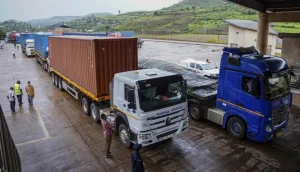
Rwanda is actively dismantling economic borders to foster trade. A significant geopolitical and economic development is the initialing of the Regional Economic Integration Framework (REIF) between Rwanda and the DR Congo. Following a peace agreement signed four months prior, this deal is viewed by analysts as a “good reason to be optimistic” regarding future economic cooperation and stability between the two nations.
Simultaneously, financial infrastructure is being linked across borders. Rwanda and Tanzania have initiated discussions to interconnect their retail payment switches (RSWITCH and TIPS), a move designed to enable real-time, cross-border money transfers between bank accounts and mobile wallets. This digital integration is essential for reducing friction in cross-border trade within the East African Community.
On a continental scale, the macroeconomic outlook remains positive despite global trade fragmentation. Africa’s real GDP growth is projected at 4.2% for 2025, supported by buoyant private consumption and a weaker US dollar which is aiding disinflation efforts.
Diversifying Capital Markets: Green and Islamic Finance
Kigali is rapidly diversifying its capital markets to attract new forms of liquidity. The Rwanda Stock Exchange (RSE) is set to launch the Green Exchange Window (GEW), a dedicated platform for trading green, social, and sustainability-linked securities. This aligns with national sustainability goals, as evidenced by Rwanda achieving 81% of its unconditional mitigation targets under the Paris Agreement, a milestone reported at COP30 in Brazil.
In a parallel effort to become a financial hub, Rwanda is introducing Islamic finance to its capital markets. By adhering to Sharia law—which prohibits interest and speculation—this move aims to unlock new investment flows from the Islamic world and diversify the financial products available to investors.
The Technology Frontier
The market data also points to a surge in technological adoption in the financial sector. The African Development Bank (AfDB) has committed approximately $300 million (Rwf 432 billion) to Rwanda’s agriculture sector for the coming year, likely integrating modern efficiencies. Broader tech trends are also reshaping the continent, with the UAE announcing a $1 billion initiative to expand AI infrastructure across Africa. Additionally, the rise of digital assets is undeniable; the Africa Stablecoin Summit 2025 highlighted that over $300 billion in stablecoin transactions now flow through African markets annually, addressing challenges related to currency volatility and remittance costs.
The November 2025 insights paint a picture of a financial ecosystem that is maturing rapidly. By fortifying its banking sector against bad debts, opening up digital payment corridors with neighbors like Tanzania, and embracing specialized financial instruments like Green Bonds and Islamic Finance, Rwanda is positioning itself as a sophisticated gateway for capital in East Africa.
To understand Rwanda’s current strategy, one might view it as building a multi-adapter power strip for the region: rather than relying on a single source of energy (traditional banking), the country is installing various inputs—green finance, Islamic banking, cross-border tech, and agricultural integration—to ensure that no matter the type of capital available globally, the local economy can plug in and power up.
About The Author


SUBSCRIBE TO OUR NEWSLETTER