Rwanda Pig Farm Transformation through the Circular Economy of Kubwimana Gilbert

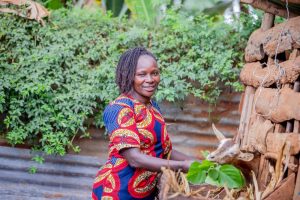
Kubwimana Gilbert, a pig farmer from the Gicumbi District in Rwanda, is one of the examples of the positive potential that sustainable farming practices, achieved through the concepts of the circular economy, could bring about in agriculture, as in the case of Gilbert, who has established a pig and vegetable farm.
By Ange de la Victoire DUSABEMUNGU
The central element of Gilbert’s strategy encompasses the efficient use of pig manure and by-products, which has contributed immensely to increased agricultural productivity.
Gilbert does not treat the manure as a resource that poses a problem but rather as an element that can improve soil quality. The manure, which is rich in nutrients and can be attributed solely to Gilbert’s pigs, serves as a fertilizer for vegetable farmers, resulting in improved productivity and financial gains.
This beneficial relationship between Gilbert and his community has improved his productivity and even promoted community-building; he sells fertilizer to his neighbors at very cheap rates.
As a young agri-entrepreneur, Gilbert opted to raise pigs since it is a profitable activity requiring less space. Demand for pork in Rwanda, evident due to buyers in Congo and some butcheries, makes it a thriving market. The cost of pork now is set at Rwf 12,500 per kilo, making it a very profitable investment opportunity.
Gilbert’s background in education is an important element that contributes to his success. Gilbert started his journey in the agricultural sector by studying at the university level, acquiring initial knowledge about the sector.
This initial education was supplemented by an internship program in agro-studies that lasted for a year in Israel.
This program provided him with experience regarding the practical aspects of farming. After this experience, Gilbert went back to Rwanda and began working towards realizing his plans for a business involving pig farming.

Gilbert’s business venture, Gicumbi Agri-Business Solution Ltd, complements an increasing need for high-quality breeds for pigs.
Through supplying quality breeds such as ‘Pietrain,’ ‘Landrace,’ ‘Duroc,’ and ‘Camborough,’ not only does he improve production for farmers, he also creates a support network for himself and other global farmer partners.
The ‘Circular Economy Principle’ for this business applies, as the success of more and more farmers contributes back to society and ultimately impacts the surrounding environment.
One of the main features of the circular economy in Gilbert’s farm is the emphasis on waste reduction. The pigs’ manure and urine are not treated as a problem to dispose of but as a raw material that is converted into compost.

The compost is subsequently sold to farmers in the region. This acts as an income-generating activity while ensuring that the agricultural practices in the region are environmentally sustainable.
At present, Gilbert’s farm employs ten individuals, both casual and permanent, which serves as an ideal example of how pig rearing can generate employment whereas the required labor force should not be overwhelming.
Additionally, this not only serves to increase Gilbert’s efficiency but also helps to sustain the economy of the surrounding area by creating jobs for the locals.
Like in every farming project, pork production has its set of faced challenges, particularly relating to market prices.
Despite this, Gilbert appears optimistic about his project due to an improvement in pig prices.
His experiences indicate that for any project to be successful, it requires knowledge, skill, and proper marketing to overcome difficulties. Having veterinarians available also reduces health problems for his animals.

Kubwimana Gilbert’s success in incorporating circular economy principles in his pig farming business is a success model of sustainable agriculture in Rwanda. Through recycling, building on social linkages, and understanding quality and market demand, Gilbert not only improves his productivity but is also a part of a sustainable agricultural landscape in his country.
The more young people like Gilbert who take up the challenge of applying circular economy practices in their business endeavors related to agriculture in Rwanda, the better the prospects of agriculture in this region.


About The Author


SUBSCRIBE TO OUR NEWSLETTER