Cooperative Empowerment Drives Hunger and Poverty Reduction in Kayonza
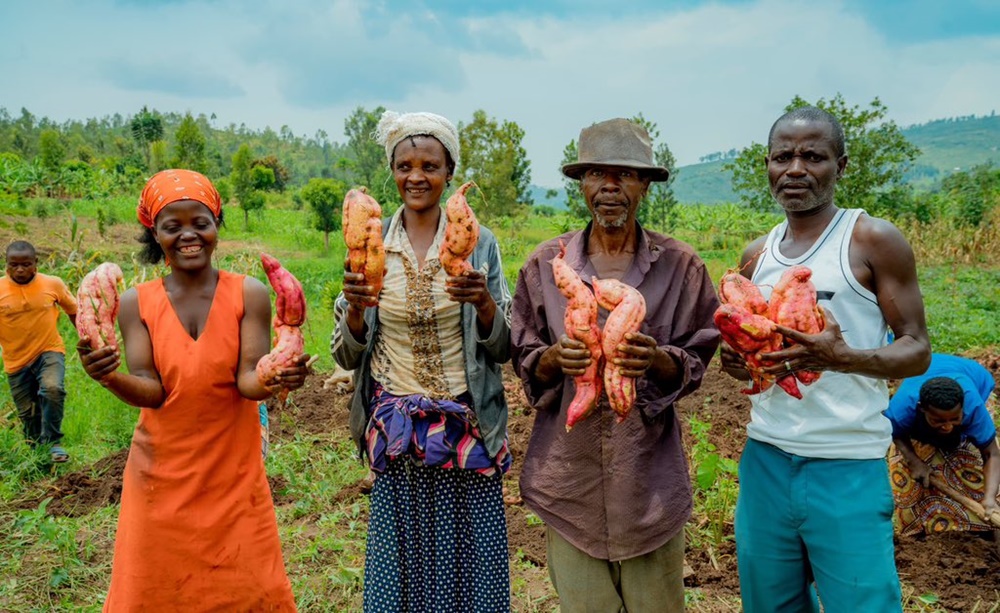
In the dry hills of Kayonza District, where long dry spells once left farmers counting losses instead of profits, a quiet transformation is unfolding. In Mwiri Sector, cooperatives that once struggled to find markets and survive unpredictable seasons are now reporting stable harvests, diversified crops, and renewed hope.
At the center of this shift is the Kayonza Irrigation and Integrated Watershed Management Project – Phase II (KIIWP2), a government-led initiative designed to strengthen climate resilience and boost rural incomes.
From Uncertain Markets to Organized Production

“Our cooperative was founded in 2021 and brings together 253 members,” says Sylvestre Ntagasanzwe, President of KOPUAIM Cooperative in Nyamugari Cell. “We operate on 17 hectares growing maize, beans and soya.”
For years, production was not their biggest problem. Marketing was.
“After harvest, sometimes we could not find a market. Other times, we were forced to sell at very low prices. Even when yields were good, income remained uncertain,” he explains.
That began to change when KOPUAIM joined KIIWP2.
The project provided training in modern farming techniques, proper land preparation, and timely planting. Members received improved seeds adapted to local climate conditions and fertilizer to restore soil productivity.
“We learned to see farming not as routine work, but as a planned and organized activity,” Ntagasanzwe says.
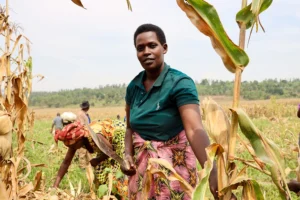
The results are visible in the fields. Even after dry seasons, the cooperative now harvests at least 2.5 tons of maize per hectare, rising to 4.5 tons in good seasons.
Sweet Potatoes: A New Weapon Against Hunger
One of the most significant changes has been crop diversification, particularly into sweet potato production and vine multiplication, a first for many members in Mwiri.

Theresie Kabarere, a member of KOPUAIM, recalls how things used to be:
“We used to practice traditional farming only for home consumption, without surplus for the market,” she says.
“Now we grow and multiply sweet potato vines and sell them. This is the first harvest we have obtained after receiving support from KIIWP2, and it is the first time we have seen such a yield. We are confident that we will no longer face hunger.”
On two hectares, the cooperative multiplies improved sweet potato vines, selling each bundle at 1,500 RWF. Fresh sweet potatoes fetch around 300 RWF per kilogram.
“The fertilizer improved our soil, and the improved vines gave us strong and healthy crops,” Kabarere adds. “What once produced little is now producing abundantly.”

Beyond income, she says, the biggest relief is food security. “Hunger is gone.”
Building Financial Resilience Within the Cooperative
KOPUAIM has also established an internal support fund. Members facing financial difficulties can borrow and repay later, sometimes with a small interest after benefiting from harvest sales.
“At the end of the year, around March, we evaluate whether we made a profit or loss,” Ntagasanzwe explains. “Even if it is small, every member receives something.”
The cooperative now aims to expand into selling agricultural inputs, positioning itself as a service provider to other farmers in the community.
Conservation Meets Livelihoods
Just a few kilometers away, another cooperative is blending environmental protection with income generation.
The Environmental Conservation Cooperative (ECC), also based in Nyamugari Cell, was established in 2011 with 36 members.

“Our goal is to conserve the environment while creating income for our members,” says Eric Kanyarwanda, its president.
ECC produces seedlings of agroforestry trees, native species, and fruit trees including mango, avocado, grevillea, and ficus. Some seedlings are sold, while others are distributed within the community to combat erosion and improve soil fertility.
“We help protect land from erosion, improve soil fertility, and encourage sustainable farming,” Kanyarwanda says.
On four hectares, ECC also grows maize, soya, and beans. Yields range between 4 to 5 tons of maize per hectare and 600 to 700 kilograms of beans.
Through KIIWP2’s matching grant mechanism, ECC expects to access up to USD 5,000 to scale up seedling production and conservation activities. Under this arrangement, the project covers 70 percent of the investment, while the cooperative contributes 30 percent.
“This support will allow us to protect more land and reach more farmers,” he says.

According to Jean de Dieu Rudacogora, KIIWP2 Access to Finance Specialist, the project is not only increasing production but also addressing post-harvest losses and market access.
“KIIWP-2 will build 55 storage facilities, supply four mechanical dryers, construct three small processing plants, and create packhouses for vegetables and fruits,” he says.
These investments are expected to stabilize prices, reduce waste, and improve farmers’ bargaining power.
KIIWP2 is jointly implemented by the Government of Rwanda in partnership with the International Fund for Agricultural Development (IFAD) through the Ministry of Agriculture and Animal Resources and executed under the Rwanda Agriculture and Animal Resources Development Board (RAB).
The project operates in nine drought-prone sectors of Kayonza: Gahini, Kabare, Kabarondo, Murama, Murundi, Mwiri, Ndego, Ruramira and Rwinkwavu. It aims to improve food security and incomes for at least 40,000 rural households while strengthening resilience to climate change.
So far, 31,359 individuals have benefited, with women accounting for 54 percent and youth 30.6 percent of participants. Ultimately, the initiative is expected to reach 180,000 people.


About The Author


SUBSCRIBE TO OUR NEWSLETTER