RwandaAgriShow2025: How APEFA’s CSA, Irrigation, and Fish Farming Are Powering a New Agricultural Boom

Among more than 500 exhibitors attending the Rwanda AgriShow2025 in Kigali, an event showcasing transformative agricultural innovations, is APEFA, a non-governmental organization dedicated to promoting climate-smart agriculture and food security in Rwanda.
ALSO READ THIS: Special Offer for 2025 EXPO in Rwanda
This year, APEFA (Action pour la Protection de l’Environnement et la Promotion des Filières Agricoles) is presenting three key initiatives: environmentally friendly farming practices, the “Five Trees per Household” program, and solar-powered irrigation technologies with fish farming.
These initiatives are implemented through various projects that work directly with farmers organized in cooperatives across districts where APEFA operates.
Diane Tuyisenge, APEFA’s Agriculture Lead, explained that solar-powered irrigation systems are designed to make efficient use of water resources and protect soil health while ensuring high yields.
“With this system, farmers can cultivate crops year-round. Even during dry seasons, they are still able to farm,” she said.
Water from lakes or other sources is pumped uphill using solar energy, significantly reducing carbon emissions compared to diesel-powered pumps. Once lifted, the water is stored in reservoirs and then gravity-fed into the fields.
To optimize water use, the water ponds are also used in fish farming, enabling farmers to benefit from both crop production and fish farming.
Tuyisenge explained, “As fish feed is placed in the water, it mixes with the water used for irrigation, enriching the soil with organic fertilizer and increasing agricultural yields.”
Regarding the “Five Trees per Household” program, Tuyisenge noted that it was launched by the Ministry of Agriculture and Animal Resources in October 2024 and is currently being implemented by APEFA.

The program began in Rubavu District, where over 5,000 fruit trees were planted. Each household received five trees to care for, while additional trees were planted in schools. Plans are also underway to establish community fruit orchards managed by youth, who will generate income while adding value to fruit production.
“We believe this program can solve many problems. Right now, fruits are expensive due to low supply. If every farmer grows five fruit trees, availability on the market will increase, and people will first eat before thinking of selling. This will help fight malnutrition, especially among children, and benefit adults too. Moreover, as more trees are planted, it will also contribute to reducing carbon emissions,” Tuyisenge added.
In its first phase, the project is being rolled out in 11 districts including Rubavu, Kicukiro, Rusizi, Nyamasheke, Karongi, and Rutsiro, among others.
APEFA also promotes conservation agriculture, which not only boosts productivity but also protects the soil.

Studies have shown that soil mismanagement significantly contributes to harmful greenhouse gas emissions. Tuyisenge pointed out that, for example, when planting cassava, it is better to dig specific holes of about 60 centimeters in width and depth and plant only in those, rather than tilling the entire land.
Such planting holes collect rainwater, which helps prevent soil erosion and provides moisture for crops to grow. The holes are filled with dry grass and the soil that was removed should be mixed with organic fertilizer before planting the cassava which will need to be mulched later. This method makes the soil softer and enables healthy root development, resulting in stronger and more productive cassava plants.
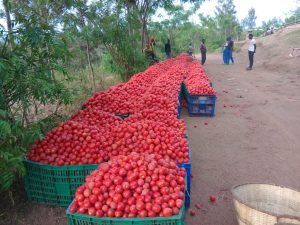
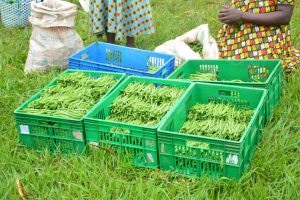
Olive Mutimanama, a farmer from Karambo Cell in Ngoma Sector, Rulindo District, expressed gratitude to APEFA for providing irrigation equipment to their cooperative, enabling them to water vegetable and fruit crops.
“Before APEFA’s support, we didn’t have the means to irrigate our fields. Our harvests were low. Back then, we could only sell around two tons of produce, but now we have more. Whether it rains or not, we have vegetables throughout the year because we farm every season. APEFA’s work has really empowered us,” she said.
“To avoid wasting rainwater, we rear fish in the dam sheets during the rainy season and then use that same water for irrigation during the dry season.”
Her cooperative has worked with APEFA since 2017 and grows a variety of vegetables and fruits.
Also attending AgriShow 2025, Mutimanama highlighted how the event helps farmers learn from each other by sharing agricultural innovations and applying the new knowledge to improve their own practices.


About The Author


SUBSCRIBE TO OUR NEWSLETTER