UR-CAFF Bridges Gap Between Farm and Classroom with “Uplift Agriculture Project” and Industry Partnerships

MUSANZE DISTRICT, Rwanda – The University of Rwanda College of Agriculture, Forestry, and Food Sciences (UR-CAFF) has initiated a comprehensive effort to transform Rwanda’s agricultural sector by directly linking academic research with the private sector.
Central to this initiative is the “Uplift Agriculture Project,” a program designed to empower farmers—particularly youth and women—through modern innovation and skills development.
Addressing the “Innovation Paradox
The initiative addresses a critical challenge identified by Prof. Dr. Thomas Bayer, Director of Hochschule Neu-Ulm University of Applied Sciences (HNU), a key partner in the project.

In a keynote address regarding sustainable development, Prof. Bayer described an “Innovation Paradox”: while global research output is at an all-time high, major global problems persist because of the difference between Knowledge and Solutions.
To solve this, Prof. Bayer advocated for a model where universities act as “Innovation Engines,” industries serve as “Scalers and Investors,” and entrepreneurs function as “Translators” to bridge the gap.
“Our responsibility is to ensure that what we teach is not theoretical alone,” Prof. Bayer stated, emphasizing that students must focus on applied research that actually reaches rural farmers.
The Uplift Agriculture Project aims to operationalize these concepts by ensuring knowledge generated within the university contributes meaningfully to the national economy.
The project connects research institutions with private sector partners to enhance productivity and promote climate-resilient agriculture.

According to Dr. Nathan Kanuma Taremwa, Director of Research and Innovation at UR-CAFF, the college is already seeing results.
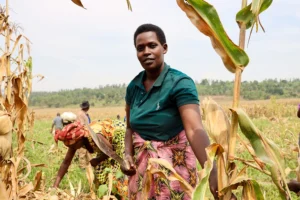
“One of our recent studies on climate-resilient maize varieties is already being piloted by local farmers,” Dr. Taremwa revealed, noting that the college’s role is to ensure adoption, not just publication.
The college is also running incubator programs to help students turn their ideas into agribusiness startups.
A New Framework for Collaboration
To sustain these efforts, UR-CAFF has outlined a formal framework for University-Industry Linkages (UIL). This includes the formation of a “College-Industry Board” tasked with advising the college on industry trends to ensure curriculum relevance and enhance graduate employability.
Key roles of this collaboration include Curriculum Development, Resource Mobilization, Technology Transfer and Student Placement in both professional internships and industrial placements.
Dr. Guillaume Nyagatare, Principal of CAFF, emphasized that these partnerships are strategic engines for practical innovation rather than just mechanisms for fundraising.
“To translate groundbreaking research into real-world solutions, we need more than just public funding; we need the agility, expertise, and market reach that only the industry can provide,” Dr. Nyagatare said.
Partnerships in Action
The initiative has already attracted significant partners who are ready to contribute to the success of this project.
In an Interview with TOP AFRICA NEWS Media, Ishimwe Marie Eudoxie, Head of Partnership at the Albertine Rift Conservation Society (ARCOS Network), noted that through this initiative, their collaboration with UR-CAFF will provide students with opportunities to engage in real-world conservation projects.
“By signing an MoU with UR-CAFF, we expect to create a dynamic platform for joint research, student engagement, and knowledge exchange that directly contributes to sustainable agriculture and natural resource management.” She said.
Dr. MANIRERE Jean D’Amour, the Campus Administrator, highlighted that these collaborations are essential for Rwanda’s National Strategy for Transformation (NST2).
He issued a call to action for innovators: “Don’t wait for the university to find you. When you see that your work can make a difference, take the first step and become part of the solution”.
This sentiment was echoed by Prof. Bayer’s call to “act like a startup” by building, piloting, and iterating solutions without waiting for policy changes.
Through the Uplift Agriculture Project and robust industry linkages, UR-CAFF aims to prove that education equals industry needs and innovation equals economic impact.


About The Author


SUBSCRIBE TO OUR NEWSLETTER