Nyamagabe Farmers Pledge to Insure Crops and Livestock Under Tekana

Farmers and livestock keepers in Nyamagabe District have pledged to enroll in the National Agriculture Insurance Scheme (NAIS), locally known as “Tekana Urishingiwe Muhinzi-Mworozi,” after an awareness campaign helped them understand how insurance could shield them from devastating losses caused by climate shocks, pests, and livestock diseases.
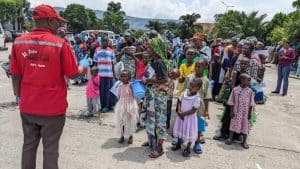
The commitment was made during an ongoing mobilization campaign led by the Rwanda Agriculture and Animal Resources Development Board (RAB) in collaboration with district authorities, as part of a broader effort to scale up agricultural insurance coverage across Rwanda’s Southern Province.
For many farmers, the decision comes after years of painful experiences marked by losses they now believe could have been avoided.

Venelande Baziruruhuka, a farmer from Gatare Sector, says learning how Tekana compensates insured farmers was a turning point for him.
“From today, I have decided to join the Tekana program and insure both my crops and livestock,” he said. “Before, I did not understand how compensation works when a farmer faces disasters.”
Baziruruhuka recalls losing five cows in 2020, a loss he estimates at nearly six million Rwandan francs, after he failed to insure them.
“At that time, we had no insurance, so we buried the cows and absorbed the loss alone. If I had insured them, I would today be among the strongest livestock farmers,” he said.
His crop losses followed a similar pattern. In 2024, pests and diseases wiped out most of his Irish potato harvest on 50 ares of land, leaving him with just one tonne instead of the expected five to six tonnes.
“I lost more than six hundred thousand francs. If I had been insured, I would have been compensated. That is why I have now decided to join insurance without hesitation,” he said, adding that he plans to encourage fellow farmers to do the same.

For Sifa Mukashyaka, a farmer from Kitabi Sector, the campaign revived her confidence in agricultural insurance after previously dropping out.
“I once insured livestock I received through the PRISM project, but later withdrew,” she said. “At the time, I did not fully understand how compensation works when an animal dies.”
She admits selling livestock before fully appreciating the long-term value of insurance but says her mindset has changed.
“From today, I have made a firm decision to insure my animals again, and I will not step back,” she said.

Another farmer from Kitabi Sector, Emmanuel Habakwihorera, said understanding the risks associated with farming convinced him to insure his cattle.
“I had heard about Tekana before, but I did not understand it well,” he said. “Today, I clearly see its benefits. If a disaster strikes, I could face huge losses, which is why I now feel strongly motivated to insure my cows.”
Nyamagabe District Vice Mayor in charge of Economic Development, Thaddée Habimana, said farmer response to Tekana continues to grow each year, often surpassing district targets.

“Tekana is increasingly being embraced by our citizens,” he said. “Each year, we set performance targets, and we consistently work to exceed them because our goal is for all farmers and livestock keepers to adopt insurance.”
He shared progress figures for the current agricultural year, noting that Nyamagabe District is steadily advancing toward its insurance coverage targets across both crops and livestock. For maize, the district aims to insure 300 hectares, of which 152 hectares have already been covered, with another farming season still ahead. Although rice production is limited in the district, all 20 hectares currently under cultivation are fully insured.
In Irish potatoes, one of the district’s key crops, 92 hectares have been insured out of a total of 195 hectares, while 39 hectares of beans have so far been covered under the scheme.
Progress has also been recorded in livestock insurance. Out of a target of 3,296 cattle, about 1,700 have already been insured. Poultry insurance has reached 6,622 birds, representing 82 percent of the district’s target of 8,000, while pig insurance currently stands at 1,173 animals against a target of 2,000.
The vice mayor urged farmers to view insurance as a necessity rather than an option.
Launched in 2019 by the Ministry of Agriculture and Animal Resources (MINAGRI), the National Agriculture Insurance Scheme (NAIS) is implemented by the Rwanda Agriculture and Animal Resources Development Board (RAB) through its Single Project Implementation Unit, in partnership with private insurance companies.
To make the scheme affordable, the government subsidizes 40 percent of insurance premiums for smallholder farmers.
Since its launch, NAIS has insured about 189,734 farmers and livestock keepers, representing roughly six percent of Rwanda’s farming population. The government has invested Rwf 5.95 billion in premium subsidies, while Rwf 8.19 billion has been paid out in compensation, Rwf 3.57 billion for livestock and Rwf 4.62 billion for crops.
The scheme covers key crops including rice, maize, potatoes, beans, chili, soybeans, French beans, and cassava, as well as livestock such as cattle, pigs, poultry, and fish.

About The Author


SUBSCRIBE TO OUR NEWSLETTER