Hashimamungu Turns Two Goats into a 41-Goat Herd in Gisagara

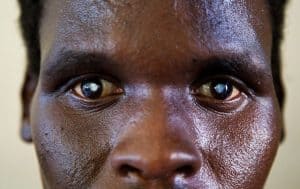
What began with just two goats in 2021 has grown into a thriving small livestock enterprise for Deo Hashimamungu, a resident of Rugomero Village in Nyaruteja Cell, Nyanza Sector of Gisagara District.
Hashimamungu credits the transformation of his livelihood to support from the Partnership for Resilient and Inclusive Small Livestock Markets (PRISM) project, which provided him with the first animals that set him on a path toward financial independence.
“When I started livestock farming in 2021, PRISM gave me two goats. One of them was pregnant and soon gave birth to two kids,” he recalls. “I continued raising them, and those kids also reproduced. Later the mother goat gave birth to three more, and the number kept increasing.”

Today, Hashimamungu owns 41 goats, a dramatic increase from the two he received four years ago.
The growth of his herd has not only improved his household income but also enabled him to participate actively in community savings groups.
“After reaching this level, I joined four savings groups in the village,” he says. “Most of the money I earn comes from the breeding services offered by my male goats.”
Hashimamungu currently owns eight male goats, which farmers in the area bring their goats to for breeding at a fee of 1,000 Rwandan francs per service. In some weeks, he says, four to five farmers come for the service, providing him with a steady source of income.
The earnings have helped him save money regularly and meet financial obligations.
“Before PRISM, I survived by moving from place to place looking for casual jobs every day,” he explains. “Now I can even hire people to work for me because I can sell livestock whenever I need money.”

A mature goat can fetch at least 80,000 RwF at the market, giving him a reliable financial safety net.
Beyond goats, the project also expanded his livestock portfolio. PRISM later provided him with 10 chickens, and he has since diversified further.
“Now I have seven chickens and eight sheep,” he says.
Hashimamungu says goat farming has allowed him to address urgent household needs quickly.
“Whenever I face a problem, I can simply take a goat to the market,” he explains. “It helps me pay for health insurance very quickly and has also solved the problem of getting manure for my crops.”
Income from livestock has also enabled him to invest in land.
“I was able to buy a plot of land worth 100,000 RwF thanks to goat farming,” he adds.
Looking ahead, Hashimamungu has even bigger ambitions.
“My target this year is to raise enough resources to start cattle farming and buy more land,” he says.

Jean Paul Habineza, the Vice Mayor of Gisagara District in charge of Economic Development, says the project has been instrumental in supporting vulnerable families through livestock distribution and training.
“PRISM has provided small livestock to many families through a graduation program designed to lift people out of poverty,” Habineza says. “Pigs, chickens and goats have played a crucial role in improving livelihoods.”
He also notes that improved economic conditions have helped reduce tensions within households.
“The support provided by PRISM has enabled families to meet basic needs and reduced the financial pressures that often cause conflicts,” he adds.
According to district data, 4,275 farmers in Gisagara have received training through the PRISM project. A total of 1,529 farmers received 15,290 chickens, 489 farmers received 750 pigs, and 726 farmers received 1,452 goats.
The project has also supported agricultural productivity and household welfare in other ways. 910 households received 3,285 avocado seedlings, while 123 households were provided with water tanks and 152 households received solar home kits.
Additionally, 1,753 farmers were supplied with 34,122 kilograms of vegetable seeds, and 550 households received animal forage support.
To strengthen livestock markets and veterinary services, the project has also invested in infrastructure, including a small livestock market in Save Sector’s Rwanza Village and a livestock veterinary clinic in Kabuga Village, Ndora Sector, both of which are now operational.
Implemented by the Rwanda Agriculture and Animal Resources Development Board (RAB) and funded by the International Fund for Agricultural Development (IFAD), PRISM operates in 15 districts across Rwanda, targeting pig, poultry, goat and sheep value chains with a budget of USD 45 million.


About The Author


SUBSCRIBE TO OUR NEWSLETTER